AI Meditation Tools Benefits: Your 2026 Energy Guide

AI meditation tools are defined as adaptive, AI-driven apps that generate personalized guided sessions based on your current emotional state, energy level, and practice history. The core ai meditation tools benefits go beyond relaxation: clinical research shows consistent app-based meditation reduces anxiety symptoms by up to 31% and depressive symptoms by 46% over eight weeks. That is a large effect, comparable to what structured therapy programs produce. Unlike static audio tracks or scheduled classes, AI tools respond to what you bring to each session, making them genuinely useful for people who want more energy, not just more calm.
1. What benefits do AI meditation tools offer over traditional methods?
Traditional meditation classes run on fixed schedules and deliver the same content to every person in the room. AI meditation apps flip that model entirely. They adapt in real time to your mood, your available time, and your history with the practice.
The most direct advantage is availability. AI tools deliver on-demand sessions the moment stress spikes, whether that is 7 a.m. before a difficult meeting or 11 p.m. after a rough day. No booking, no waiting, no commute. That immediacy changes how often people actually practice.

Personalization is the second major advantage. AI systems hold conversations before sessions and remember your preferences to evolve guided meditation over time. A session you do on monday after a bad night of sleep looks different from one you do on friday after a productive week. That context sensitivity is something no pre-recorded library can replicate.
Key advantages AI tools hold over traditional formats:
- Immediate access: Sessions available 24 hours a day, 7 days a week, without scheduling
- Context awareness: Sessions adapt to your stated mood, energy, and situation each day
- Persistent memory: The app recalls your history and builds on previous sessions
- Cross-tradition techniques: AI draws from breathwork, body scan, visualization, and other methods based on what fits your current need
- Habit support: Reminders, streaks, and progress tracking lower the friction of showing up consistently
Pro Tip: Describe your situation in specific terms when you open a session. “Tired and distracted after three back-to-back calls” produces a far more targeted session than “stressed.”
2. How AI meditation tools enhance mental well-being and energy levels
The mental health case for AI meditation is grounded in measurable outcomes, not marketing claims. A Carnegie Mellon review found that 10–21 minutes of meditation three times weekly produces significant reductions in stress biomarkers and improvements in emotional regulation. That is a short time investment with a documented return.
Energy is where AI tools separate themselves from generic mindfulness apps. Most meditation products aim for calm, which often means slower, sleepier states. AI tools that adapt to your specific context, including what is draining you that day, can produce sessions that leave you sharper and more focused rather than ready for a nap. Mosaiic is built explicitly around this distinction, positioning its sessions as energy-focused rather than sedation-focused.
“Consistency driven by adaptive AI tools is a key predictor of long-term meditation benefits.” — AI Meditation: Helpful Guide or Wellness Shortcut?
The table below summarizes the documented mental well-being outcomes from app-based meditation practice:
| Outcome | What the research shows |
|---|---|
| Anxiety reduction | Up to 31% reduction over 8 weeks of consistent practice |
| Depression symptom relief | Up to 46% reduction over the same 8-week period |
| Stress biomarkers | Measurably reduced with sessions as short as 10–21 minutes, three times weekly |
| Emotional regulation | Improved self-regulation and reduced reactivity with adaptive session formats |
| Sleep quality | Adaptive evening sessions support daily calm and improved sleep onset |
Sleep improvement is worth calling out separately. When a session is built around what actually happened to you that day, your nervous system has a specific target to process. Generic relaxation tracks cannot do that. AI-generated sessions that reference your actual context close that gap.
3. What features should you look for in AI meditation tools?
Not all AI meditation apps deliver the same depth of personalization. The difference between a tool that genuinely helps and one that just plays ambient music with a chatbot wrapper comes down to a few specific features.
Persistent memory is the most important one. An app that forgets your last session cannot build on your progress. Look for tools that track your history and use it to shape what comes next. Mosaiic does this by design: each day’s session builds on the previous one, evolving as you progress.
Depth of personalization matters just as much. Personalized AI apps adapt technique, style, and content based on ongoing feedback and usage patterns, drawing from a cross-tradition range that includes breathwork, body scan, visualization, and mindful movement. A tool locked into one technique will plateau quickly.
Features that separate strong AI meditation tools from basic ones:
- Context input: Can you describe your specific situation before each session, or does the app only ask for a mood rating?
- Session length flexibility: Does the app adjust duration based on your available time and energy?
- Feedback loops: Does the app ask how you felt after a session and use that to improve the next one?
- Habit-building mechanics: Reminders, streaks, and progress milestones reduce dropout
- Interface simplicity: The fewer taps between opening the app and starting a session, the better
Reducing decision fatigue is a real feature benefit. Apps that recommend where to start and tailor sessions to your input lower the mental barrier that stops beginners from building a habit. This is especially relevant if you are new to meditation and unsure which technique fits you.
Pro Tip: Use the 2026 meditation app features checklist to evaluate any tool before committing to a paid tier. Persistent memory and context input are the two features most worth verifying.
4. How AI supports habit formation and consistent practice
Consistency is the single biggest predictor of whether meditation produces lasting results. One session a month does nothing. Three sessions a week for eight weeks produces the clinical outcomes cited above. The problem is that most people do not stick with it.
AI-enabled apps boost adherence by adapting session length and content based on your motivation and history. On a low-energy day, the app shortens the session rather than demanding the same 20 minutes you did last week. That flexibility removes the all-or-nothing thinking that kills most new habits.
Active engagement with AI meditation apps yields greater benefits than passive listening to generic tracks. This means the more specific information you give the app, the better the session it generates, and the more likely you are to return. The feedback loop between user input and session quality is what makes AI tools genuinely different from a playlist.
Understanding how user input shapes your practice is worth studying if you want to get the most from any AI meditation tool. The apps that ask better questions before each session tend to produce better outcomes.
5. Are there any drawbacks or cautions when using AI meditation tools?
AI meditation tools have real limitations. Knowing them upfront helps you use these tools well rather than running into avoidable problems.
The most documented risk is over-reliance on AI guidance, which can delay the development of independent meditation skills. If you always need a voice in your ear to settle your mind, you have not actually built the skill. Experts recommend using AI as scaffolding, then integrating solo, unguided practice as your confidence grows.
AI tools can also misinterpret data and lack nuanced empathy, making hybrid approaches with human teachers beneficial for advanced practice. An AI cannot read the room the way a skilled teacher can. For people working through grief, trauma, or serious mental health challenges, a human practitioner remains the appropriate primary support.
Other limitations to keep in mind:
- Tech dependency: Sessions require a charged device and, in most cases, an internet connection
- Engagement-first design risk: Some apps prioritize streaks and gamification over actual practice quality. Look for tools with evidence-based session design, not just high engagement metrics
- Generic outputs: Apps with shallow personalization produce sessions that feel templated. If every session sounds the same regardless of what you describe, the AI is not actually adapting
- No crisis support: AI meditation tools are wellness products, not mental health treatment. They are not substitutes for therapy or clinical care
The difference between meditation apps and classes is worth understanding before you decide how to structure your practice. Apps excel at frequency and accessibility. Classes excel at depth, correction, and human connection. The strongest practice uses both.
Key takeaways
AI meditation tools deliver the most measurable benefits when they combine persistent memory, context-specific personalization, and consistent daily use rather than passive or occasional listening.
| Point | Details |
|---|---|
| Personalization drives results | Apps that adapt to your stated context produce better outcomes than generic audio tracks. |
| Clinical outcomes are documented | Consistent app-based practice reduces anxiety by up to 31% and depression symptoms by up to 46% over 8 weeks. |
| Short sessions work | Research supports 10–21 minutes three times weekly as sufficient for measurable stress and energy improvements. |
| Avoid over-reliance | Use AI as a starting scaffold, then build in solo, unguided sessions to develop independent practice skills. |
| Feature quality varies widely | Persistent memory and context input are the two features that separate effective AI tools from basic ones. |
What I have actually learned from using AI meditation tools
The biggest surprise for me was not the stress reduction. It was the energy. I expected AI meditation to make me calmer. What I did not expect was finishing a five-minute session before a difficult conversation and feeling sharper, not sleepier. That shift in outcome changed how I thought about when to use these tools.
The personalization gap between AI tools and generic apps is real, but it only shows up when you put in the effort to describe your situation honestly. The people who get the least from AI meditation are the ones who tap “stressed” and hit play without thinking. The people who get the most write two sentences about what is actually going on. That small act of reflection is itself part of the benefit.
My honest caution: do not let the app become a crutch. I went through a period where I could not settle my mind without a guided session running. That is not meditation skill. That is just audio dependency. The fix was simple: one session per week with no guidance, just a timer. It felt uncomfortable at first. That discomfort was the point.
AI tools have genuinely democratized access to quality meditation. Someone in a small town with no access to a skilled teacher can now get a session calibrated to their specific situation every single day. That is not a small thing. But the technology works best when you treat it as a starting point, not a destination.
— Giorgio
Mosaiic: personalized sessions built around your energy
If you have been reading about AI meditation tools benefits and want to see what context-driven personalization actually feels like, Mosaiic is worth trying. The app generates a fresh five-minute guided session each day based on what you describe, whether that is burnout, low motivation, or a rough stretch at work. Each session builds on the last, so the practice evolves with you rather than repeating the same script.
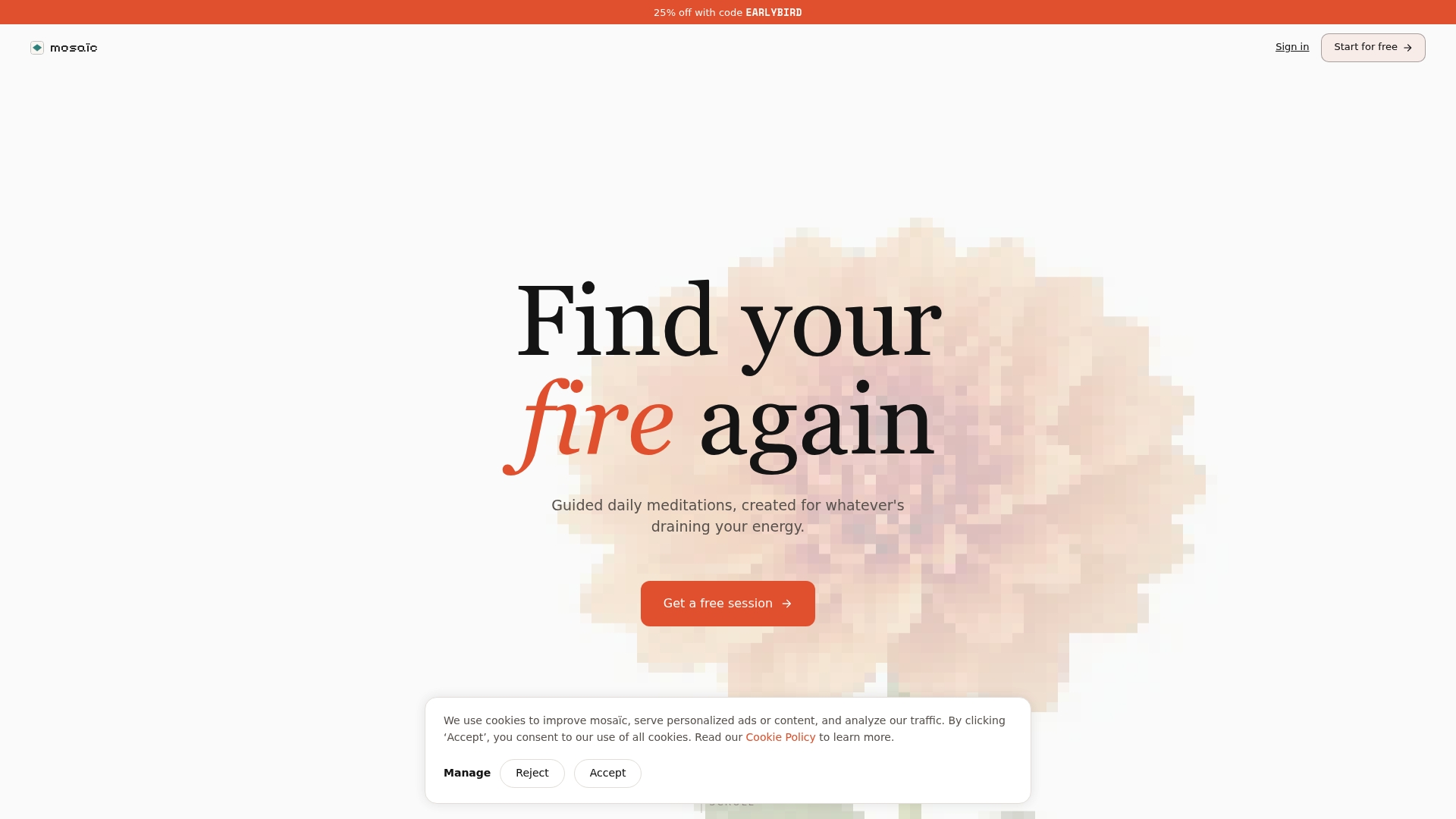
Mosaiic is positioned around energy, not just calm. The sessions are designed to leave you fuller and more focused, not ready for a nap. A free tier is available so you can experience a personalized guided session before committing to a paid plan. If you want a tool that actually responds to your situation rather than playing ambient music, Mosaiic is a direct answer to that need.
FAQ
What are the main benefits of AI meditation tools?
AI meditation tools deliver personalized, context-aware sessions that adapt to your mood and history, producing documented reductions in anxiety and depression symptoms with consistent use. The core advantages over static formats are real-time adaptation, persistent memory, and on-demand access.
How long does it take to see results from AI meditation apps?
Clinical research shows measurable reductions in anxiety and depressive symptoms after eight weeks of consistent practice. A Carnegie Mellon review found that sessions as short as 10–21 minutes, three times weekly, produce significant improvements in stress biomarkers and emotional regulation.
Can AI meditation tools replace a human meditation teacher?
AI tools close the accessibility gap by providing immediate, personalized support anytime, but they do not replace human teachers for advanced practice. AI lacks nuanced empathy and cannot respond to subtle cues the way a skilled instructor can, making a hybrid approach the strongest option for serious practitioners.
What should I look for when choosing an AI meditation app?
Prioritize persistent memory, context input before each session, and flexible session length. Apps that adapt based on your specific situation and track your progress over time produce better outcomes than those offering only mood ratings or fixed-length tracks.
Is it possible to become too dependent on AI meditation guidance?
Yes. Over-reliance on guided sessions can delay the development of independent meditation skills. Experts recommend using AI tools as scaffolding and gradually introducing unguided solo sessions to build genuine self-regulation capacity.