Why Meditation Apps Differ from Classes: Key Insights

Meditation apps and traditional classes represent two structurally different approaches to mindfulness practice, each built around opposite assumptions about what a meditator needs. Apps offer on-demand, guided audio sessions designed for accessibility and convenience. Classes provide live instruction, real-time feedback, and communal practice. Understanding why meditation apps differ from classes matters because the format you choose shapes not just your schedule but the depth, sustainability, and direction of your practice. This article breaks down the structural, instructional, and social distinctions so you can make a genuinely informed choice.
Why meditation apps differ from classes in structure and format
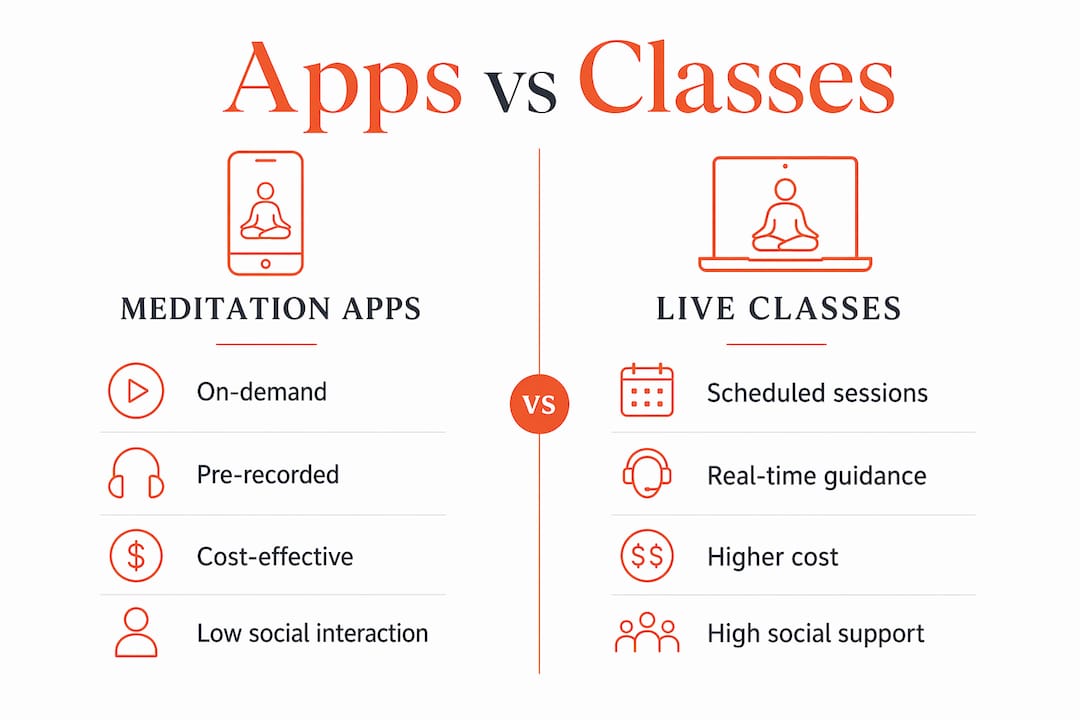
The most immediate difference between apps and live classes is how they are built around your time. Meditation apps deliver sessions averaging 10 to 21 minutes, designed to fit fragmented schedules. Traditional classes typically run 30 to 45 minutes and follow a fixed schedule at a specific location or live video link. That gap is not just about length. It reflects a fundamentally different relationship with commitment.
Apps lower the barrier to entry as far as it can go. You open the app, tap a session, and you are practicing. There is no commute, no registration, and no social pressure. This accessibility is real and valuable, especially for beginners. The top 10 meditation apps have been downloaded over 300 million times, which tells you that the format works as a starting point for an enormous number of people.
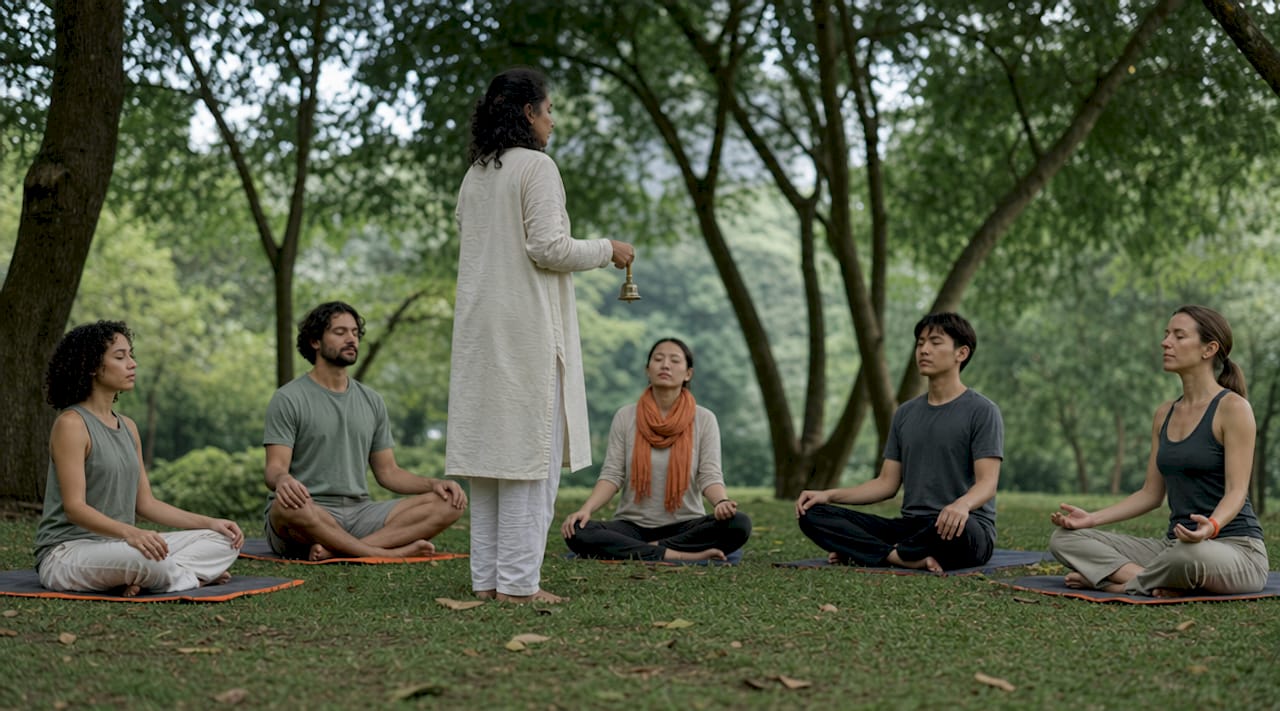
Classes ask more of you upfront. You commit to a time, show up, and practice alongside others. That friction is not a flaw. It creates the conditions for consistency in a way that an always-available app rarely does. The differences in meditation formats are not just logistical. They reflect different theories about what makes a practice stick.
Key structural contrasts at a glance:
- Session length: Apps average 10 to 21 minutes; classes run 30 to 45 minutes
- Scheduling: Apps are on-demand; classes have fixed times
- Access: Apps require only a smartphone; classes require travel or a live video link
- Commitment level: Apps are low-friction entry points; classes involve social accountability
- Cost: Apps range from free to roughly $70 per year; classes vary widely but often cost more per session
Pro Tip: If you are new to meditation, start with an app for two to four weeks to build a baseline habit. Then try a single live class to experience what structured, communal practice feels like before deciding which format fits your life.
How do apps and live classes differ in personalization and guidance?
This is where the gap between the two formats becomes most significant. Apps deliver pre-recorded audio. No matter what you are feeling when you press play, the session plays the same way it did yesterday. A live teacher watches the room, reads the energy, and adjusts. That real-time responsiveness is the core of what makes in-person instruction different.
Meditation apps rarely explain the “why” behind the techniques they teach. If you feel restless during a body scan, the app cannot tell you whether that is normal, whether you should push through, or whether a different technique would serve you better. A teacher can. This matters more than it sounds. Without context, practitioners often interpret difficulty as failure and quit.
The clinical evidence for apps is real. Headspace, for example, has over 50 peer-reviewed publications supporting its effectiveness for stress reduction after just two weeks of use. That is meaningful. But clinical validation for stress reduction is not the same as a developmental path for practice growth.
Traditional meditation features a developmental arc that apps do not replicate. Concepts like shifting attention, recognizing stages of concentration, and understanding how experience changes over months of practice are taught in classes and almost never addressed in app content. Serious practitioners eventually notice this ceiling.
Here is what in-person instruction provides that apps structurally cannot:
- Real-time correction. A teacher can see when your posture is creating tension or when your breathing pattern is counterproductive.
- Technique progression. Classes move you from foundational breath awareness to more nuanced practices like open monitoring or loving-kindness in a sequenced way.
- Tradition context. Understanding where a technique comes from and why it was developed helps practitioners use it more effectively.
- Troubleshooting. When practice gets difficult, a teacher can distinguish between productive discomfort and a sign to change approach.
- Personalized feedback. Your specific questions get specific answers, not a generic guided track.
Pro Tip: When evaluating a live class, ask the teacher directly how they handle students who plateau or feel stuck. Their answer tells you more about the quality of instruction than any course description.
What role does social interaction play in apps versus classes?
The social dimension of meditation is underappreciated in most app-versus-class comparisons. Apps are solitary by design. You practice alone, with headphones, in whatever space you have. Some apps include community forums or group challenges, but these are thin substitutes for shared practice. Live classes provide a relational container where teacher interaction and peer presence normalize difficulty and reinforce commitment.
The data on apps and social wellbeing is more nuanced than most people expect. 62% of stress relief from meditation apps is linked specifically to reduced feelings of loneliness. That is a striking finding. It means apps do provide a form of social benefit, even without face-to-face contact. But it also means that a significant portion of the app’s effectiveness depends on addressing isolation, not just teaching technique.
Group meditation reduces “blank-page” anxiety for beginners and enhances focus through collective energy. Sitting in a room where everyone else is also trying to stay present creates a kind of social permission to take the practice seriously. That effect does not exist when you are alone with your phone.
| Factor | Meditation apps | Live classes |
|---|---|---|
| Social accountability | Minimal; self-directed | High; teacher and peers present |
| Community support | Forum-based, asynchronous | Real-time, relational |
| Shared practice energy | Absent | Present and reinforcing |
| Normalization of difficulty | Rare; no live feedback | Active; teacher addresses struggles |
| Long-term engagement | Low retention after 30 days | Higher with structured cohorts |
The Buddhist concept of sangha, or community of practitioners, exists for a reason. Shared practice creates conditions that solo practice cannot. Apps can reduce loneliness. They cannot replicate belonging.
What are the practical benefits and drawbacks of each format?
Choosing between app-based meditation and live classes is not a question of which is better. It is a question of what you need right now and what you are building toward. Both formats have genuine strengths and real limitations.
Meditation app advantages:
- Immediate access with no scheduling friction
- Cost-effective, especially for beginners
- Consistent session quality regardless of teacher variability
- Works for people in locations without access to quality in-person instruction
- Effective for stress reduction and sleep improvement with short, frequent use
Limitations of apps:
- Only about 4.7% of initial users remain active after 30 days, with average lifetime use between one and four sessions. That retention rate signals a structural problem with engagement, not just individual motivation.
- Apps can create dependence on guided audio, preventing practitioners from developing the capacity to generate their own meditative state without external instruction.
- No developmental arc means serious practitioners hit a ceiling and stall.
Live meditation class benefits:
- Progressive instruction that evolves with your practice
- Real-time feedback and troubleshooting
- Social accountability that supports consistency
- Access to tradition, lineage, and deeper context
- Teacher relationships that sustain long-term growth
Limitations of classes:
- Fixed schedules that conflict with demanding lives
- Higher cost per session
- Quality varies significantly by teacher and studio
- Geographic limitations for those outside urban centers
Apps serve as accessible entry points that lower barriers for cost-conscious beginners. That role is legitimate and valuable. The risk is treating the entry point as the destination. Experienced practitioners consistently transition from apps to classes when they seek tradition, progression, and community. That pattern is not accidental. It reflects what each format is actually built to deliver.
For a deeper look at how context-specific meditation can bridge the gap between generic app content and personalized practice, the distinction becomes even clearer in practice.
Key takeaways
Meditation apps and live classes serve different stages of practice, and the format you choose determines whether your meditation deepens or plateaus.
| Point | Details |
|---|---|
| Structural format differs fundamentally | Apps offer 10 to 21 minute on-demand sessions; classes run 30 to 45 minutes with fixed schedules. |
| Personalization gap is significant | Apps use pre-recorded audio with no real-time adjustment; teachers adapt guidance to individual needs. |
| Social accountability drives retention | Live classes provide communal energy and teacher feedback that apps cannot replicate. |
| App retention is critically low | Only 4.7% of users remain active after 30 days, pointing to a structural engagement problem. |
| Apps are entry points, not endpoints | Serious practitioners move from apps to classes when they need progression, tradition, and community. |
Where I land after years of watching both formats
The debate between apps and classes often gets framed as a technology question. I think that framing misses the point. The real question is what stage of practice you are in and what you actually need from it.
Apps solved a genuine access problem. Before Headspace and similar tools existed, most people had no practical way to try meditation without finding a studio, signing up for a course, and committing to a schedule before they even knew if they liked it. Apps removed that friction, and the result was hundreds of millions of people who would never have tried meditation otherwise. That is worth acknowledging.
But I have watched too many people spend two or three years on apps and wonder why their practice feels stuck. The answer is almost always the same. Apps are built for retention, not progression. The business model rewards you coming back tomorrow, not outgrowing the product. That creates a subtle but real misalignment between what the app is optimized for and what your practice actually needs.
The practitioners I find most interesting are the ones who used an app to build the habit, then found a teacher or a community to take it somewhere. That sequence works. What does not work is treating the app as a complete practice environment indefinitely. The daily evolution of meditation is not something a static library of recordings can provide. At some point, your practice needs to respond to where you actually are, not where the algorithm thinks you should be.
Technology will keep improving. Adaptive, context-aware tools are already changing what app-based meditation can do. But the human relationship between teacher and student, and the shared energy of a room full of people practicing together, are not features that can be added to an interface. They are the thing itself.
— Giorgio
How Mosaiic approaches the gap between apps and real practice
Most meditation apps give you a library and leave you to figure out what you need. Mosaiic works differently. You describe what is actually draining you right now, whether that is burnout, a rough week, or a loss of direction, and the app generates a five-minute guided session written specifically for that context. Each session builds on the last, so your practice evolves as you do rather than cycling through the same generic tracks.
The positioning is deliberate: energy, not just calm. Mosaiic is built to leave you clearer and more capable, not sleepier. If you want to understand what adaptive meditation looks like in practice, the approach is worth exploring. Three tiers are available, from a free sample through to the Daily plan for full personalization.
Start with Mosaiic and see what a session built around your actual situation feels like.
FAQ
Why do meditation apps differ from in-person classes?
Meditation apps deliver pre-recorded, on-demand sessions averaging 10 to 21 minutes, while in-person classes provide live instruction, real-time feedback, and communal practice in structured 30 to 45 minute sessions. The core difference is that apps optimize for accessibility and apps cannot adapt to individual needs in the moment the way a teacher can.
Are meditation apps as effective as live classes?
Apps are clinically validated for stress reduction and anxiety relief, with Headspace backed by over 50 peer-reviewed studies. For beginners seeking stress relief, apps work well. For practitioners seeking progression, depth, and technique development, live classes consistently outperform app-based formats.
Why do so many people stop using meditation apps?
Only 4.7% of initial meditation app users remain active after 30 days, with most averaging between one and four total sessions. The primary reasons are lack of accountability, absence of social reinforcement, and no developmental arc to keep practice moving forward.
Can meditation apps replace the community aspect of classes?
Apps reduce loneliness and provide some social benefit, but they cannot replicate the shared energy, real-time accountability, and relational depth of group practice. The Buddhist concept of sangha exists precisely because communal practice creates conditions that solo practice does not.
When should someone move from an app to a live class?
The right time to transition is when your practice feels repetitive, when you have questions the app cannot answer, or when you notice you are dependent on guided audio to meditate at all. These are reliable signals that you have outgrown what the format can offer and are ready for teacher-led instruction.