Adaptive Meditation Explained: Boost Energy and Clarity

Adaptive meditation is a dynamic mindfulness practice that adjusts its content, pacing, and technique in real time based on your current mental and physiological state. Unlike fixed scripts or rigid 20-minute routines, adaptive meditation responds to where you actually are right now, whether you’re running on empty after a brutal week or struggling to focus through a fog of low motivation. Tools like biometric wearables, AI-driven session generators, and multi-agent personalization systems make this possible at scale. EEG research confirms that measurable brain changes begin within just 2 to 3 minutes of breath-focused practice, which means even a short, well-targeted session can shift your mental state fast. The goal is not calm for its own sake. It is restored energy and sharper clarity.
What is adaptive meditation and how does it work neurologically?
Adaptive meditation is defined by one core principle: the session changes based on you, not the other way around. Traditional mindfulness-based stress reduction (MBSR) programs, developed by Jon Kabat-Zinn at the University of Massachusetts, use fixed curricula delivered over eight weeks. Adaptive formats break from that model by reading your current state and selecting techniques accordingly. The recognized industry term for this category is context-sensitive or personalized mindfulness, and adaptive meditation is the consumer-friendly label for the same concept.
What the brain actually does during a session
Brain activity changes during breath-watching meditation begin within 2 to 3 minutes and peak around the 7-minute mark across beginners, novices, and advanced practitioners alike. This means the window for neurological benefit is shorter than most people assume. The shifts involve increases in alpha waves (associated with relaxed alertness), theta waves (linked to creative and associative thinking), and beta1 waves (tied to focused attention). Together, these changes produce the mental state most people describe as “clear-headed and present.”
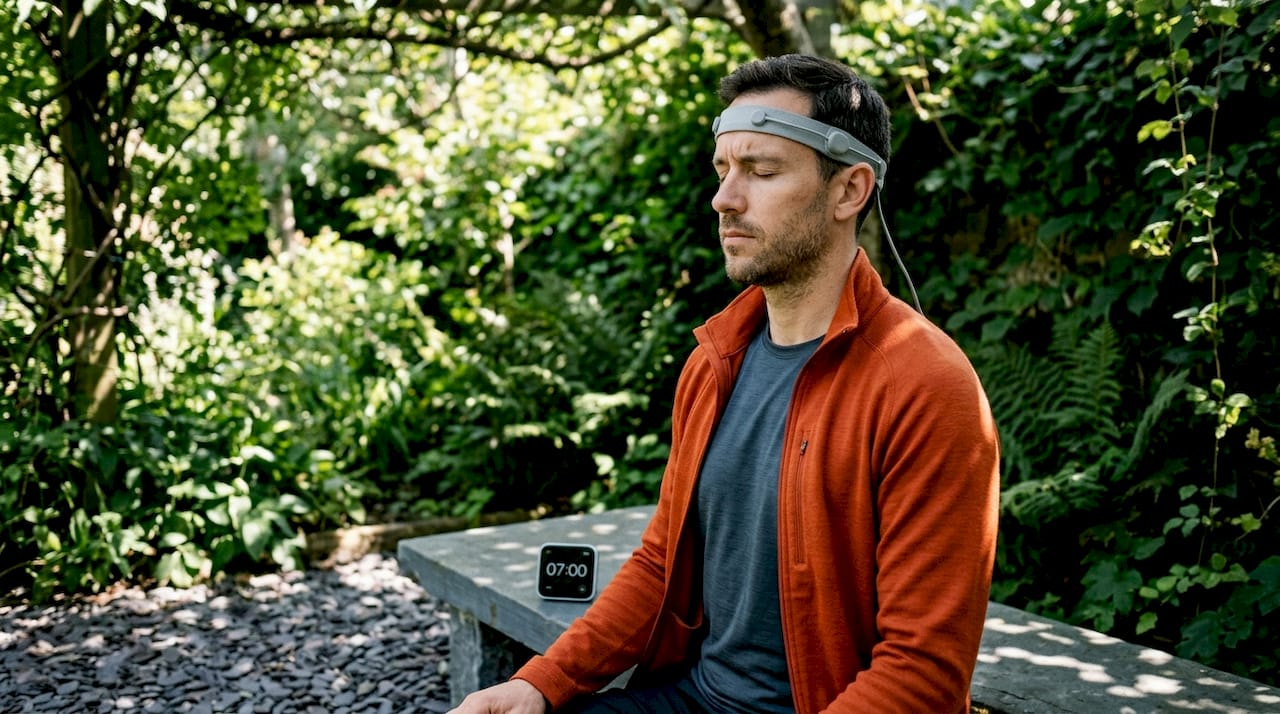
After just 7 days of intensive practice, participants in a 2026 study showed measurable neuroplasticity markers, increased glycolytic metabolism, elevated endogenous opioids, and balanced immune signaling. That is not a minor mood lift. Those are biological changes that affect how your body manages stress and how your brain allocates cognitive resources. For anyone dealing with burnout or sustained pressure, this is the mechanism that makes meditation more than a relaxation trick.
Advanced practitioners show broader and more stable alpha and theta activity compared to beginners, but the timing of when those waves appear is consistent across experience levels. This matters because it validates short sessions. You do not need an hour of silence to move the needle on mental clarity.
Pro Tip: Set a 7-minute timer for your next session. Research shows this is when brainwave changes peak, making it the most neurologically efficient duration for a quick energy reset.
| Brainwave | State it produces | Benefit for energy and clarity |
|---|---|---|
| Alpha | Relaxed alertness | Reduces mental noise without inducing drowsiness |
| Theta | Creative, associative thinking | Supports problem-solving and idea generation |
| Beta1 | Focused attention | Sharpens concentration during demanding tasks |
How does adaptive meditation differ from traditional methods?
Traditional meditation methods, including Transcendental Meditation, Vipassana, and MBSR, share a structural assumption: the same technique works for everyone at every session. You follow a script, hold a posture, and repeat a mantra or body scan regardless of whether you slept four hours or eight. That rigidity is a feature for some practitioners. For people navigating unpredictable stress loads, it is often why they quit.
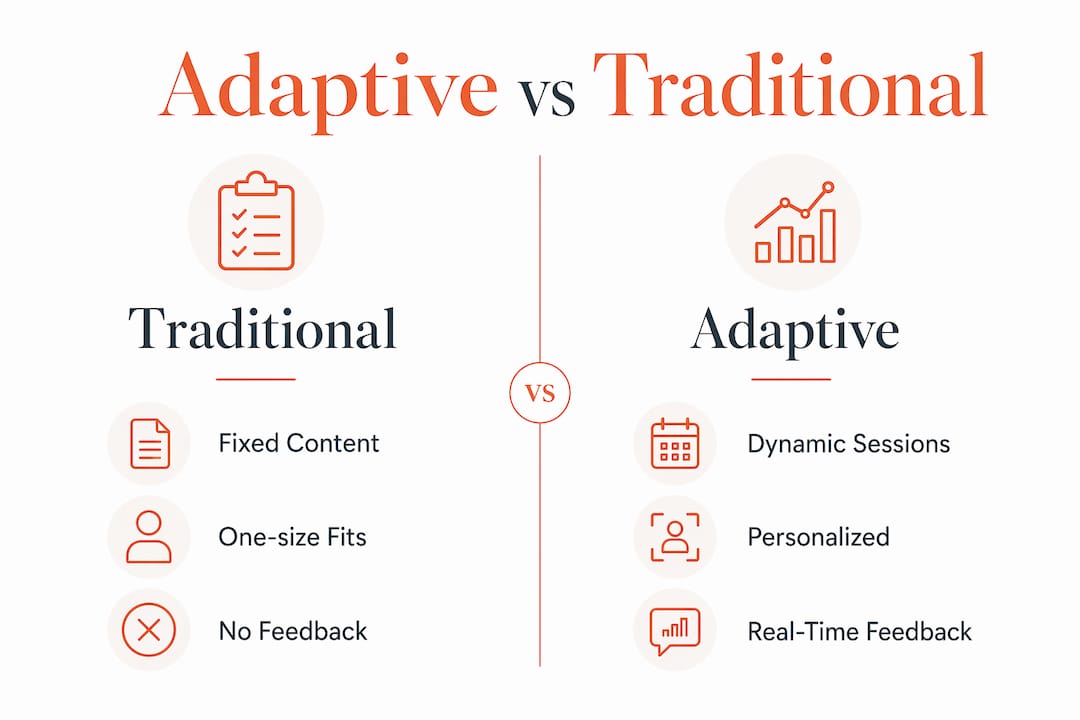
Adaptive meditation replaces that fixed structure with a feedback loop. Your emotional input, biometric data, or even a brief written description of your current state feeds into the session design. The result is a practice that meets you where you are rather than where a curriculum assumes you should be. Personalized digital mindfulness systems show statistically significant improvements in engagement, stress reduction, and self-awareness compared to static formats, particularly over longer deployment periods.
Core differences at a glance
| Feature | Traditional meditation | Adaptive meditation |
|---|---|---|
| Session content | Fixed script or technique | Adjusts based on current state |
| Duration | Predetermined (20-45 min typical) | Flexible, often 5-10 minutes |
| Personalization | None or minimal | Real-time, context-driven |
| Technology | None required | Apps, wearables, AI systems |
| Best for | Committed long-term practitioners | Busy individuals with variable stress loads |
The engagement advantage of adaptive formats is not trivial. A randomized controlled trial comparing synchronous and asynchronous online MBCT found that real-time interaction reduced dropout rates compared to self-paced formats. Adaptive meditation extends this logic further: when a session feels directly relevant to your current state, you stay with it. And staying with practice is how you realize the biological benefits described above.
Key reasons adaptive formats outperform static ones for energy-focused users:
- They address the specific drain you are experiencing today, not a generalized stress profile
- Short, targeted sessions fit into real schedules without requiring lifestyle overhaul
- Real-time feedback prevents the frustration of using a calming technique when you actually need activation
- Personalization sustains motivation across weeks and months, not just the first few days
How to practice adaptive meditation for energy and mental clarity
The foundation of any adaptive practice is the same skill that underlies all mindfulness: training attention and awareness of your internal experience without judgment. Adaptive systems do not replace that skill. They create better conditions for developing it by removing the friction of choosing the right technique at the right moment.
Here is a practical framework for getting started:
-
Identify your current state before you begin. Spend 60 seconds asking yourself what is actually draining you right now. Is it mental fatigue, emotional weight, physical tension, or scattered focus? This single step is what separates adaptive practice from autopilot meditation.
-
Choose or generate a session matched to that state. If you are using an app like Mosaiic, describe your situation in plain language and let the system generate a session. If you are practicing without technology, select a technique that fits: breath counting for scattered focus, body scan for physical tension, open awareness for emotional heaviness.
-
Start with 7 minutes. Brain activity peaks around the 7-minute mark, making this the most efficient duration for a quick clarity boost. Longer sessions (20 to 30 minutes) are valuable for deeper work, but 7 minutes is enough to shift your state on a busy day.
-
Track what changes. After each session, note your energy level and mental clarity on a simple 1 to 5 scale. Over two weeks, patterns emerge. You will see which techniques consistently restore your focus and which ones leave you feeling flat.
-
Adjust based on feedback, not habit. The defining feature of adaptive practice is that yesterday’s session does not automatically become today’s. If your state has shifted, your session should too. Resist the pull toward routine for its own sake.
-
Use wearables as optional amplifiers, not requirements. Devices like the Oura Ring or WHOOP can provide heart rate variability data that informs session selection. They are useful but not necessary. Your own honest self-assessment is a valid input signal.
Pro Tip: If you notice your mind resisting a session because it feels too calm or too slow for your current state, that resistance is data. Switch techniques rather than pushing through. Adaptive practice means honoring that signal.
For people dealing with financial stress or other specific life pressures, pairing adaptive meditation with targeted stress management strategies compounds the benefit. The meditation addresses the physiological stress response; the strategy addresses the source.
What role does technology play in adaptive meditation today?
Technology is what makes adaptive meditation scalable beyond one-on-one coaching. The current generation of platforms uses three distinct mechanisms to personalize sessions.
The first is biometric integration. The Mortis Matrix app, launched in April 2026, aggregates real-time biometric and behavioral data to generate frequency-tuned meditation sessions matched to the user’s current physiological state. This represents consumer-grade adaptive meditation at its most technically sophisticated.
The second is AI-driven content generation. Research on LLM-powered multi-agent systems shows that large language models can analyze user inputs and generate personalized mindfulness guidance that outperforms static content on engagement metrics. The MindfulAgents framework, published in 2026, demonstrates how expert-aligned AI systems can replicate the personalization logic of a skilled meditation teacher.
The third is Dynamic Personalized Optimization (DPO). DPO frameworks integrate multimodal data including mood reports, session history, and biometric signals to continuously refine session content. Importantly, current implementations use LLMs to assist data analysis rather than generate content directly, and most lack peer-reviewed clinical validation of outcomes.
That last point deserves attention. The mechanisms are credible. The marketing claims often outpace the evidence. Before committing to any biometric-driven platform, verify what signals it actually measures and whether those signals have been validated in published clinical trials. Personalization built on unvalidated proxies can feel sophisticated while delivering little more than a randomized session selector. Context-specific meditation approaches that are grounded in established mindfulness research offer a more reliable starting point than novelty-driven tech alone.
Key takeaways
Adaptive meditation works because it matches technique to your actual state in real time, producing faster neurological benefits and higher long-term adherence than fixed-format practices.
| Point | Details |
|---|---|
| Brain changes are fast | EEG data shows neural shifts begin within 2 to 3 minutes and peak at 7 minutes. |
| 7 days changes biology | One week of intensive practice produces neuroplasticity and immune system shifts. |
| Personalization drives adherence | Sessions matched to your current state reduce dropout and sustain long-term practice. |
| Technology amplifies but does not replace | AI and wearables improve personalization; self-awareness remains the core skill. |
| Validate before you trust | Check whether any app’s biometric signals have clinical validation before relying on them. |
Why I think most people are using meditation wrong for energy
Most meditation content is designed to calm you down. That is useful for anxiety. It is actively counterproductive when what you need is to feel more alive and focused. I have spent years watching people abandon meditation not because it failed them, but because they were using a sedative when they needed a stimulant.
The neuroscience of adaptive meditation changes that framing entirely. When you match technique to state, you are not just relaxing. You are training specific brainwave patterns that correspond to the mental performance you actually want. Alpha for clear-headed presence. Beta1 for sharp focus. Theta for the kind of lateral thinking that solves problems. The daily evolution of practice is not a luxury feature. It is the mechanism.
My caution is this: do not let the technology become the practice. Wearables and AI generators are scaffolding. The real work is developing the ability to read your own state accurately and respond with skill. That is a human capacity, and no app builds it for you. Use the tools to lower the barrier to entry, then gradually trust your own judgment more. The goal is a practitioner who can adapt without a device, not a user who is permanently dependent on one.
— Giorgio
Start practicing adaptive meditation with Mosaiic
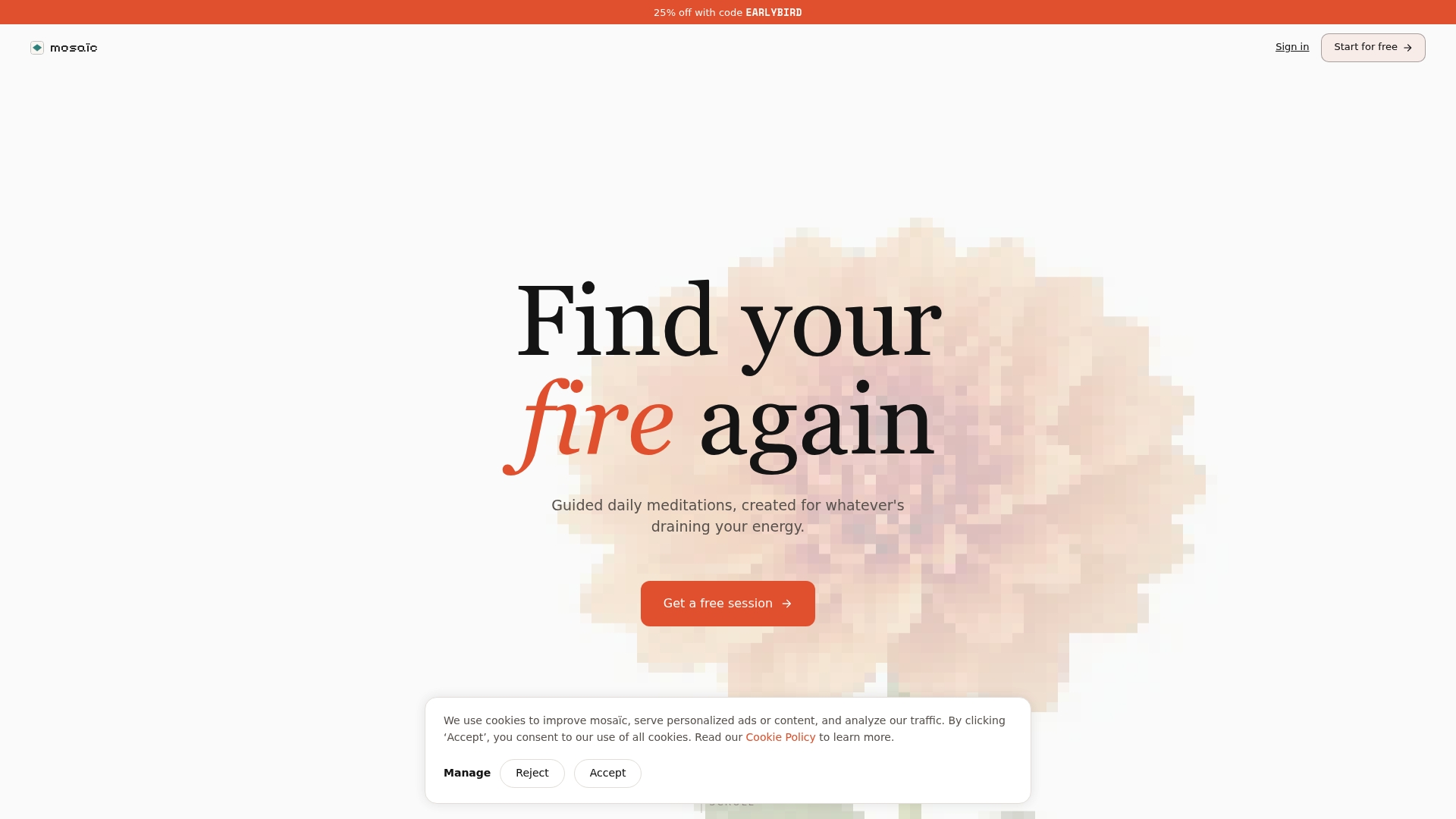
Mosaiic is built on exactly the principle this article describes: your meditation session should respond to what is actually draining you today, not a generic stress profile. You describe your situation in plain language, and Mosaiic writes and narrates a 5-minute guided session specific to that context. Each day’s session builds on the last, so your practice evolves as you do. The positioning is explicit: energy, not just calm. If you are ready to experience personalized adaptive sessions that leave you sharper and more energized rather than sleepy, Mosaiic offers a free tier to start with no commitment required.
FAQ
What is adaptive meditation in simple terms?
Adaptive meditation is a mindfulness practice that changes its technique, pacing, and content based on your current mental or physical state. It contrasts with fixed-format practices like Vipassana or standard MBSR, which use the same approach regardless of how you feel.
How quickly does adaptive meditation improve mental clarity?
EEG research shows brain activity shifts begin within 2 to 3 minutes of breath-focused practice and peak around 7 minutes, meaning even a short session can produce measurable improvements in focus and alertness.
Do I need a wearable device to practice adaptive meditation?
No. Wearables like the Oura Ring or WHOOP can provide useful biometric data, but honest self-assessment of your current state is a valid and sufficient input for adapting your session. Technology amplifies personalization; it does not create it.
How does adaptive meditation differ from MBSR?
MBSR, developed by Jon Kabat-Zinn, uses a fixed eight-week curriculum delivered the same way to all participants. Adaptive meditation adjusts session content in real time based on individual state, making it more responsive to variable stress loads and more sustainable for people with unpredictable schedules.
Can adaptive meditation help with burnout specifically?
Yes. The morning energy activation approach within adaptive practice targets the specific depletion patterns associated with burnout, including mental fatigue, emotional numbness, and loss of motivation, rather than applying a generic relaxation response.