Meditation Session Progression Tracking: Your 2026 Guide

Meditation session progression tracking is the practice of systematically recording your meditation activities and reflections to measure growth, consistency, and long-term mindfulness development. Most practitioners meditate for weeks without any record of what changed, which sessions felt different, or whether their practice is actually building momentum. Tools like Meditary, Ta-Da!, and Zen Garden now make it possible to capture both the raw numbers and the emotional texture of every session. When you combine that data with a structured session progress journal, patterns emerge that would otherwise stay invisible.
What tools and metrics are essential for meditation session progression tracking?
Effective meditation tracking splits into two distinct categories: quantitative metrics and qualitative metrics. Quantitative data tells you what happened. Qualitative data tells you why it mattered.
Quantitative metrics are the numbers most apps surface by default:
- Streak counters show consecutive days practiced, which builds initial habit momentum
- Session duration records how long each sit lasted, in seconds or minutes
- Frequency stats display sessions per week, month, or year
- Cumulative time aggregates total practice hours across your history
Meditary implements all four through streak counters, calendar heat maps, and detailed time metrics, letting you visualize progress across multiple timeframes in a single dashboard. That kind of visual density makes it easy to spot gaps before they become habits.
Qualitative metrics require a little more intention but deliver far more insight:
- Post-session mood ratings (a simple 1 to 5 scale works)
- Technique tags (body scan, breath focus, loving-kindness)
- Context tags (pre-work stress, poor sleep, grief, low energy)
- Free-text reflections or voice notes
Ta-Da! supports session-seconds counting alongside voice reflections after each sit, giving you context that pure duration data cannot provide. That combination of objective dose and subjective state is what separates a log from a real progression record.
For practitioners inside the Apple ecosystem, Mindful Minutes aggregates practice duration across apps after permission is granted, writing data directly to Apple Health. This makes it a passive, cross-app benchmark for physiological and psychological benefit comparisons.
Pro Tip: If you use multiple apps, connect them all to Apple Health so your Mindful Minutes reflect your total practice, not just one app’s slice of it.
Privacy is a legitimate concern for many meditators. Zen Garden stores all session data locally on your device, offering emotional trend analysis, session calendars, and duration impact insights without any cloud storage. Long-term tracking does not require surrendering your data to a server.
| Tool | Strength | Best for |
|---|---|---|
| Meditary | Streak counters, calendar views, time metrics | Visual habit builders |
| Ta-Da! | Voice reflections, rhythms model | Reflective practitioners |
| Zen Garden | Local storage, emotional trend analysis | Privacy-conscious users |
| Apple Health Mindful Minutes | Cross-app aggregation | Apple ecosystem users |
How to design a personal session progress journal
A session progress journal is the qualitative layer that turns raw tracking data into personal insight. Apps capture duration and frequency automatically. The journal captures everything apps miss: what you were carrying into the session, what shifted, and what you noticed afterward.
Here is a minimal structure that works without becoming a burden:
- Date and time (30 seconds). Note when you sat and for how long.
- Technique used (10 seconds). Body scan, breath anchor, open awareness, or guided audio.
- Context tag (10 seconds). One word or phrase: “pre-meeting anxiety,” “post-argument,” “low energy morning.”
- Arrival state (one sentence). How did you feel walking in? Scattered, numb, wired, flat.
- Departure state (one sentence). How did you feel walking out? Calmer, clearer, still unsettled.
- One observation (two sentences max). What did you notice that you had not noticed before?
This structure takes under three minutes and produces data that is genuinely useful after four to eight weeks. The context tags in particular become powerful when you start correlating meditation patterns with life events and moods, revealing which techniques work best under specific conditions.
“Strong progression systems capture both in-session dose and post-session state via brief reflection prompts to connect objective data with subjective experience.” — Ta-Da! design principles
Ta-Da! and Meditary both offer reflection prompts built into their post-session flows, which removes the friction of staring at a blank page. If you prefer analog, a pocket notebook with pre-printed column headers achieves the same result. The format matters less than the consistency.
Pro Tip: Keep your journal entry template on a sticky note next to wherever you meditate. The fewer decisions you make post-session, the more likely you are to actually complete the entry.

Context-specific meditation logging is especially valuable when your practice is tied to specific life situations like burnout, grief, or performance pressure. Tagging those contexts creates a record of which approaches actually helped, not just which ones you tried.
How to interpret your meditation tracking data over weeks and months
The most common mistake in mindfulness progress tracking is checking data too frequently. Daily review of streak counters creates anxiety rather than insight. Monthly review creates clarity.
Reliable rhythmic patterns emerge after four to eight weeks of consistent logging, and meaningful trend patterns become visible after eight to twelve weeks. Before that window, you are looking at noise, not signal. This timeline matters because it sets realistic expectations for when your data will actually tell you something useful.
Here is what to look for at each review interval:
- Weekly (5 minutes): Did you practice at least four days? Which technique appeared most? Any obvious context patterns?
- Monthly (20 minutes): Is your average session duration trending up or down? Which context tags correlate with your best departure states? Are there day-of-week patterns?
- Quarterly (45 minutes): What has changed in your arrival states compared to three months ago? Which techniques have you stopped using and why?
The streak model has a structural flaw worth naming directly. A single missed day resets a 60-day streak to zero, which is mathematically accurate but psychologically destructive. Ta-Da!'s “Rhythms” model treats natural practice cadences as the real measure of consistency, reducing discouragement from missed days without pretending the gap did not happen. A practitioner who meditates five days a week for three months has a stronger practice than someone who maintained a 30-day streak once and quit.
| Review interval | What to measure | What to ignore |
|---|---|---|
| Weekly | Session frequency, technique variety | Duration fluctuations |
| Monthly | Context-to-outcome correlations, average duration | Individual outlier sessions |
| Quarterly | Arrival state trends, technique evolution | Streak counts |
Clinical mindfulness research reinforces this approach. A 2026 study tracked mindfulness intervention compliance using Ōura ring wear time and app logging over four months, demonstrating that objective dose measures provide far more reliable adherence data than self-reported streaks. The implication for personal practice: wearable data combined with app logs gives you a more honest picture than any single metric alone.
How to integrate meditation tracking into your daily routine
Building a tracking habit requires less willpower than most people expect. The key is reducing the number of decisions between finishing a session and completing your log.
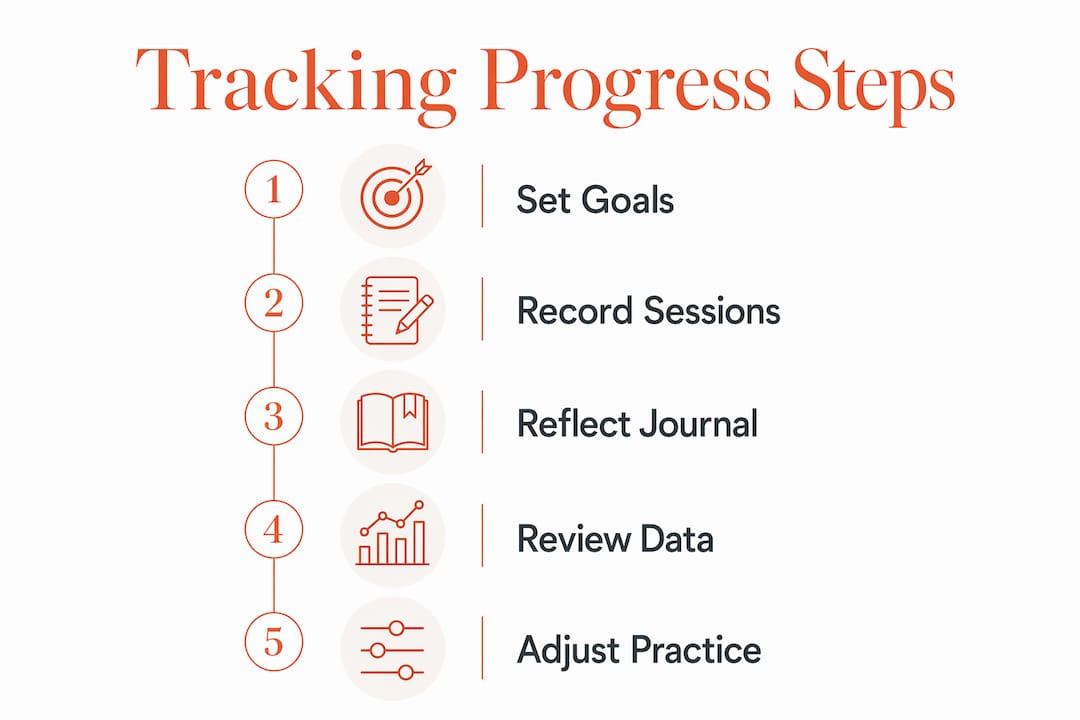
- Set a single daily reminder at a consistent time, ideally five minutes after your usual meditation window. The reminder is not to meditate. It is to log.
- Use app features designed for recovery. Missed a day? Log it anyway with a “skipped” tag. Handling missing data consistently is critical in both clinical and personal tracking to avoid distorted progress pictures.
- Connect a wearable device if you have one. Ōura, Apple Watch, and similar devices add physiological context (heart rate variability, sleep quality) that explains why some sessions feel harder than others.
- Limit your journal entry to three minutes. Longer entries are unsustainable. The goal is a consistent signal, not a comprehensive diary.
- Review on a fixed schedule. Block 20 minutes on the first of each month. Treat it like a standing appointment with your own data.
Pro Tip: If you miss three or more days in a row, do not try to reconstruct detailed entries for each missed session. Log a single “gap” entry with a brief context note and move forward. Accuracy matters more than completeness.
Building daily meditation momentum depends on making the tracking loop feel like part of the practice, not an administrative task bolted onto the end of it. When the log becomes a two-minute ritual, it stops feeling like homework.
Key takeaways
Effective meditation session progression tracking requires combining quantitative app metrics with qualitative journaling and reviewing data on a monthly rather than daily basis.
| Point | Details |
|---|---|
| Use both metric types | Combine streak counters and duration data with mood tags and context notes for full insight. |
| Reliable patterns take time | Meaningful trends emerge after 8 to 12 weeks of consistent logging, not days. |
| Replace streaks with rhythms | Measure natural practice cadences monthly to avoid discouragement from single missed days. |
| Keep journal entries short | Three-minute post-session logs are sustainable; longer entries get abandoned within weeks. |
| Integrate wearable data | Devices like Ōura or Apple Watch add physiological context that explains session quality variation. |
What consistent tracking actually taught me
Most people start tracking their meditation because they want proof it is working. That is a reasonable motivation, but it is also a trap. When you treat your data as a verdict, every difficult session feels like failure. When you treat it as observation, every session becomes information.
The practitioners I have seen make the most genuine progress are not the ones with the longest streaks. They are the ones who noticed that their Thursday morning sessions consistently felt harder than their Sunday ones, traced it back to a weekly work pattern, and adjusted their technique accordingly. That kind of insight does not come from a streak counter. It comes from eight weeks of context tags and honest departure-state notes.
The other thing worth saying plainly: quantitative metrics and qualitative journaling are not interchangeable. You need both. Duration data without reflection tells you how long you sat. Reflection without duration data tells you how you felt. Together, they tell you whether your practice is actually evolving over time or just repeating the same session in a loop.
Be patient with the pattern recognition phase. The first four weeks of data will feel inconclusive. That is normal. The signal is building. Treat your early entries as deposits, not reports.
— Giorgio
How Mosaiic supports your progression tracking
Mosaiic is built around the idea that meditation should respond to what is actually draining you, not deliver a generic calm-down script. Each session is generated from the context you describe, and each day’s session builds on the last, so your guided meditation progress is embedded in the product itself rather than tracked separately.

Every session Mosaiic generates is tied to the specific situation you described, which means your session history is inherently context-tagged. You are not logging “30-minute sit.” You are logging “burnout, week three, breath focus, felt clearer after.” That is the kind of record that produces real insight over time. Mosaiic’s Free tier lets you experience the format before committing, with Starter and Daily tiers unlocking the full progression arc.
FAQ
What is meditation session progression tracking?
Meditation session progression tracking is the systematic recording of session data, including duration, frequency, technique, and post-session reflections, to measure growth and consistency over time. It combines quantitative app metrics with qualitative journaling to produce meaningful long-term insight.
How long before I see patterns in my tracking data?
Rhythmic patterns stabilize after four to eight weeks of consistent logging, with broader trend patterns becoming visible after eight to twelve weeks. Reviewing data before that window typically produces noise rather than insight.
Are streak counters a reliable way to measure meditation progress?
Streaks measure consecutive days but reset entirely on a missed day, which makes them brittle as a primary progress metric. The Rhythms model used by apps like Ta-Da! tracks natural practice cadences instead, offering a more realistic and sustainable measure of consistency.
Can I track meditation progress without sharing data online?
Yes. Apps like Zen Garden store all session data locally on your device, providing emotional trend analysis and session calendars without cloud storage. Privacy-conscious tracking is fully viable with current tools.
What should a minimal session progress journal include?
A minimal entry needs six elements: date and time, technique used, context tag, arrival state, departure state, and one brief observation. This structure takes under three minutes and generates the contextual data needed for meaningful monthly review.