Meditation Session Customization Benefits for Energy

Meditation session customization benefits are the measurable advantages you gain when a practice is built around your specific stress triggers, mood state, and energy needs rather than a generic script. Personalized meditation, the recognized industry term for this approach, goes far beyond choosing a session length. It adapts technique, tone, pacing, and context to what you are actually experiencing right now. Research confirms that people who follow personalized stress management recommendations achieve greater stress reduction than those using standard care. Mosaiic applies this principle daily, generating guided sessions tied directly to what is draining your energy today.
1. What are the top meditation session customization benefits?
Personalized meditation delivers results that generic sessions cannot match. The core advantage is relevance. A session built around your actual situation, whether burnout, grief, or low motivation, activates engagement that a one-size-fits-all recording simply cannot.
The most consistent benefits people report include:
- Stress reduction that sticks. Tailored techniques address your specific stress pattern, not a hypothetical average user’s pattern.
- Better mood regulation. Sessions that match your emotional state in real time help you process feelings rather than bypass them.
- Higher completion rates. When a session feels relevant, you finish it. Finishing it compounds the benefit over time.
- Increased energy after practice. Personalized meditation targets restoration, not just relaxation. The goal is to leave you fuller, not sleepier.
- Emotional resilience. Personalized routines build resilience, making it easier to handle difficult situations and maintain relationships under pressure.
Pro Tip: Describe your situation in specific terms before each session. “I feel drained from a difficult conversation” gives an adaptive platform far more to work with than “I feel stressed.”
The benefit of tailored meditation sessions compounds over time. Each session that accurately reflects your current state trains your nervous system to regulate more efficiently. That is the difference between a practice that calms you temporarily and one that builds lasting capacity.

2. How technology enables effective meditation session customization
Artificial intelligence is the engine behind modern personalized meditation. AI tools generate personalized scripts by analyzing mood patterns, stated preferences, and session history. The result is a meditation that reads like it was written for you, because it was.
The most significant technological advance in this space is the ecological momentary assessment, or EMA. EMA captures your stress and mood data in real time, multiple times throughout the day. In a landmark personalized stress management trial, participants completed stress assessments three times daily over 18 weeks. That frequency of data collection allowed the system to adapt recommendations with a precision that weekly check-ins could never achieve.
Adaptive algorithms take that data and adjust the next session accordingly. If your stress scores spike on Tuesday afternoon, Wednesday’s session addresses that pattern directly. This feedback loop is what separates adaptive platforms from static libraries of pre-recorded content.
Automation also handles session sequencing. Rather than requiring you to manually select a new technique each day, the platform builds a progression. Mosaiic, for example, generates each day’s session so it builds on the previous one, evolving as you progress. That continuity produces compounding benefits that isolated sessions cannot replicate.
3. Which customization features deliver the most benefit?
Not all customization options carry equal weight. Some features produce surface-level variety. Others produce measurable changes in how you feel after a session.
Session length and pacing
Duration matters more than most people expect. A five-minute session built around your exact situation outperforms a thirty-minute generic session in terms of relevance and follow-through. Pacing, meaning how quickly the guide moves through breathing cues and reflection prompts, also affects how deeply you settle into the practice.
Technique selection
Choosing a technique based on your current goal is the highest-leverage customization available. Body scan works differently than breath focus, which works differently than visualization. Meditation apps allow technique selection based on user context, and that choice alone shifts the session’s effect on your nervous system.
Background sound and music
Ambient sound affects physiological arousal. Nature sounds lower cortisol response differently than binaural tones or silence. Giving people control over this variable removes a common friction point that causes people to abandon sessions mid-practice.
Guidance style and tone
A directive, structured voice works well for people who need grounding. A softer, more open-ended tone works better for people processing grief or emotional complexity. Matching tone to emotional state is a customization feature that most standard apps ignore entirely.
Context-specific framing
The most effective sessions open with a direct acknowledgment of your situation. Context-specific meditations report higher user satisfaction and perceived relevance compared to generic alternatives. That framing signals to your brain that this practice is for now, not for some abstract future version of you.
4. How to maximize the benefits of personalized meditation daily
Personalized meditation works best when you treat it as a daily input, not an occasional reset. Consistency is the variable that separates people who notice lasting change from those who feel temporary relief.
Practical habits that amplify the customized meditation advantages you gain:
- Describe your state specifically before each session. Vague input produces vague output. Name the emotion, the situation, and the physical sensation you are carrying.
- Complete sessions fully. Meaningful user engagement with adaptive platforms correlates directly with improved outcomes. Stopping early breaks the feedback loop.
- Track how you feel afterward. Even a one-sentence note creates a data point that helps you recognize patterns over days and weeks.
- Adjust based on life events. A session designed for low motivation is not the right tool on a day when you are managing acute anxiety. Use the platform’s input fields to reflect what is actually happening.
- Pair sessions with a physical anchor. Meditating at the same time and in the same physical space each day reduces the cognitive load of starting. That consistency makes adherence easier.
Pro Tip: If you miss a day, do not skip the input step when you return. Describing what happened during the gap gives an adaptive platform the context it needs to recalibrate your next session accurately.
The benefits of personalized meditation sessions grow proportionally with how honestly you engage with the platform. Technology handles the adaptation. You supply the raw material.
5. Are personalized meditation sessions more effective than standard ones?
The research answer is yes, with one important condition. Personalized meditation produces better outcomes when people actually follow the personalized recommendations they receive.
A 2026 randomized trial compared N-of-1 personalized stress management interventions against standard care. The N-of-1 design treats each person as their own control, cycling through different interventions to identify what works specifically for them. The results showed clear advantages for the personalized group, but only among participants who adhered to their assigned recommendations.
“The effect was stronger in participants who chose the recommended intervention, highlighting that active engagement with personalized recommendations is the critical variable in achieving better outcomes.”
Randomized Personalized Trial for Stress Management Compared to Standard of Care, Journal of Personalized Medicine, 2026
That finding reframes the question. The technology is not the limiting factor. Adherence to personalized recommendations is. Standard meditation apps remove the personalization layer, which also removes the adherence incentive. When a session feels generic, skipping it feels costless. When it was built for your specific Tuesday, skipping it feels like leaving something on the table.
Limitations in current research include relatively short study durations and self-reported outcome measures. Longer trials with objective physiological markers would strengthen the evidence base. Still, the directional finding is consistent: personalization improves outcomes when people engage with it seriously.
Key Takeaways
Personalized meditation outperforms generic practice because relevance drives engagement, and engagement drives the outcomes that actually change how you feel and function.
| Point | Details |
|---|---|
| Adherence determines results | Following personalized recommendations produces greater stress reduction than passive exposure to any meditation content. |
| EMA enables real-time adaptation | Stress assessments captured multiple times daily allow platforms to adjust sessions with far greater accuracy than weekly check-ins. |
| Technique choice is highest leverage | Selecting a method matched to your current goal produces a measurably different physiological response than rotating generic techniques. |
| Specificity of input improves output | Describing your exact situation before a session gives adaptive platforms the context needed to generate a relevant, effective script. |
| Consistency compounds the benefit | Daily personalized practice builds emotional resilience over time in a way that occasional sessions cannot replicate. |
Why I think most people are using meditation wrong
The standard advice is to meditate for calm. Sit, breathe, let thoughts pass. That framing is not wrong, but it is incomplete. It treats meditation as a way to turn down the volume on your life rather than as a tool for building the capacity to handle what your life actually demands.
What I have observed, both personally and in watching how people engage with adaptive platforms, is that the energy framing changes everything. When you approach a session asking “what is draining me right now and how do I recover from it,” you get a fundamentally different experience than when you sit down to “clear your mind.” The former is specific. The latter is vague. Specificity is what makes a practice stick.
The technology side of this is genuinely exciting, but I think people overestimate the AI and underestimate their own input. The best personalized session in the world produces mediocre results if you describe your state as “a bit stressed.” The platforms that work best are the ones that push you to be honest and specific, because that honesty is the actual raw material of personalization.
My expectation for the next few years is that the most effective platforms will get better at prompting that specificity, not just at processing it. The human element, the willingness to name what is actually happening, remains the variable that technology cannot replace.
— Giorgio
Mosaiic builds sessions around what is actually draining you
Most meditation apps give you a library. Mosaiic gives you a session written for today.
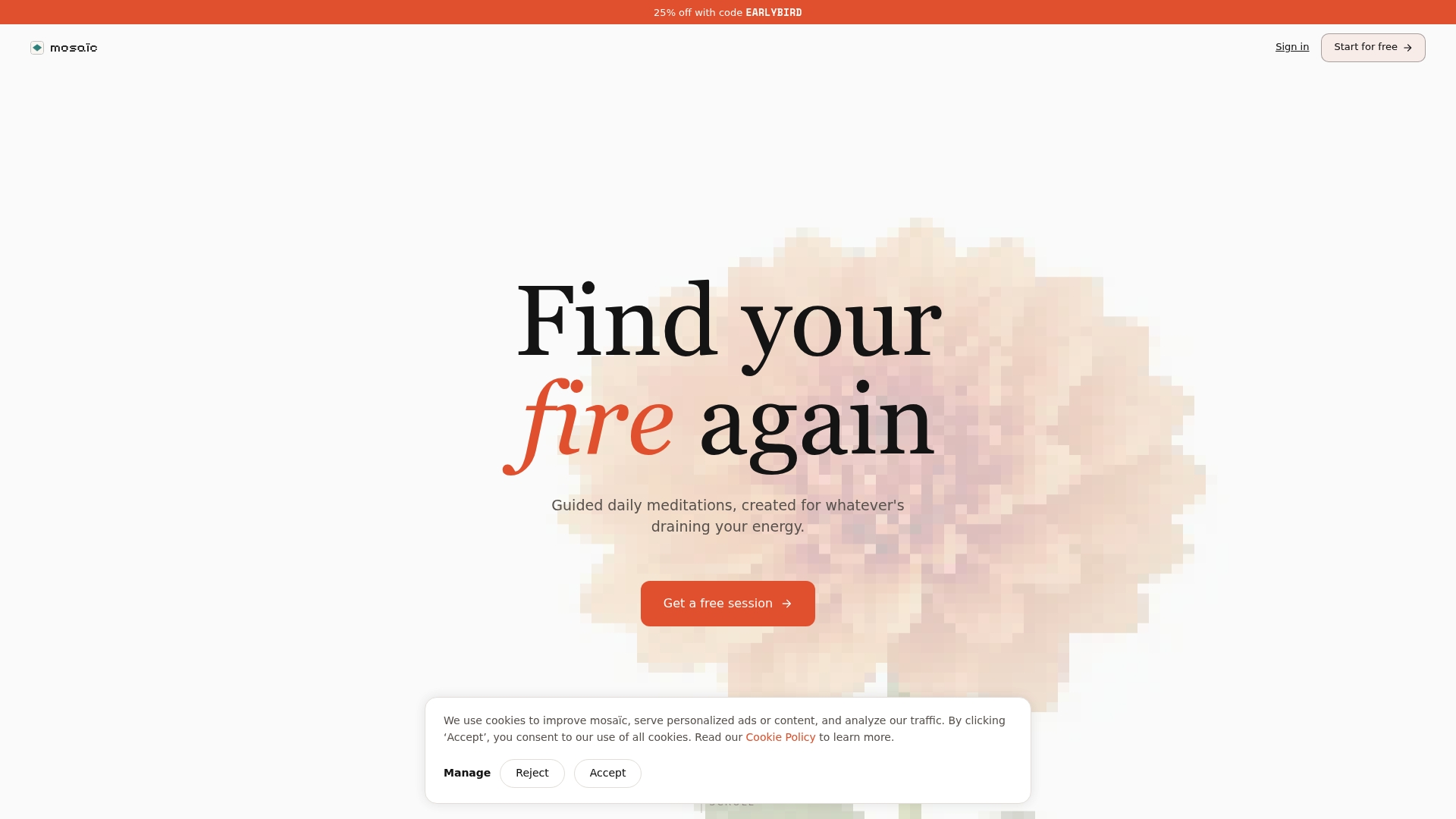
You describe your situation, whether it is burnout, a rough week, or a loss of drive, and Mosaiic writes and narrates a five-minute guided meditation specific to that context. Each session builds on the previous one, so your practice evolves as you do. The positioning is direct: energy, not just calm. Three tiers are available, Free, Starter, and Daily (Pro), so you can start with personalized sessions at whatever level fits your current commitment. If you want a practice that actually responds to your life, Mosaiic is built for that.
FAQ
What is personalized meditation?
Personalized meditation is a practice tailored to your specific mood, stress level, and goals rather than a fixed generic script. Techniques, duration, tone, and context all adapt to what you are experiencing at the time of the session.
How do meditation session customization benefits differ from standard apps?
Standard apps offer pre-recorded content that does not change based on your state. Personalized platforms adapt session content, technique, and framing in response to your input, producing higher relevance and better adherence.
Does research support personalized meditation over generic practice?
Yes. A randomized N-of-1 trial found that participants who followed personalized stress management recommendations achieved greater stress reduction than those receiving standard care.
How often should I use a personalized meditation session?
Daily use produces the strongest results. Adaptive platforms like Mosaiic build each session on the previous one, so consistency is what creates the compounding benefit over time.
What input makes a personalized session most effective?
Specific descriptions of your current situation, including the emotion, the trigger, and the physical sensation, give adaptive platforms the context needed to generate a session that actually addresses what you are carrying.