Meditation for Mental Fatigue Relief: What Works

Meditation for mental fatigue relief is a proven method for restoring depleted cognitive resources, lowering cortisol, and rebuilding mental energy. The clinical term for this process is attentional restoration, a concept rooted in directed attention theory. Mindfulness-Based Cognitive Therapy reduces overall fatigue with quality of life improvements sustained one month after intervention. Research on session length shows 10–20 minutes restores attentional performance to pre-depletion levels, outperforming passive rest. The goal is not to empty your mind. The goal is to refill it.
How does meditation relieve mental fatigue?
Mental fatigue is not the same as physical tiredness. It is the result of prolonged, effortful cognitive work that degrades the prefrontal cortex’s ability to sustain directed attention. When that system breaks down, focus collapses, decisions feel harder, and even simple tasks drain you.

Meditation works by giving the prefrontal cortex permission to disengage. Directed attention recalibration happens when the brain shifts from effortful focus to a softer, anchor-based awareness. That shift is not passive rest. It is active recovery, similar to the difference between lying on a couch and doing physical therapy after a muscle injury.
The physiological side of this is equally concrete. Meditation activates the parasympathetic nervous system, the branch responsible for rest and repair. That activation suppresses cortisol production. Micro sessions as short as 3 minutes produce measurable cortisol reduction and enable cognitive resets. That means even a brief practice between meetings has a real biological effect.
Here is what changes in the brain during a session:
- Prefrontal cortex: Releases effortful focus and begins recalibrating attention circuits
- Default mode network: Quiets ruminative thought loops that drain working memory
- Amygdala: Reduces threat-response activity, lowering the stress load on the system
- Cortisol levels: Drop within minutes of sustained breath focus
Pro Tip: If you feel too wired to sit still, that is a signal your nervous system needs parasympathetic activation first. Start with slow exhales before any formal technique.
Meditation also functions as cognitive physical therapy, retraining sustained attention circuits the same way rehabilitation rebuilds a muscle. The key is using an anchor, such as breath, sound, or a body sensation, rather than trying to achieve mental emptiness. Exhausted minds cannot hold emptiness. They can hold a simple point of focus.
What types of meditation work best for mental exhaustion?
Not every meditation style addresses mental fatigue equally. The type you choose, and the order in which you apply techniques, determines how much recovery you get.
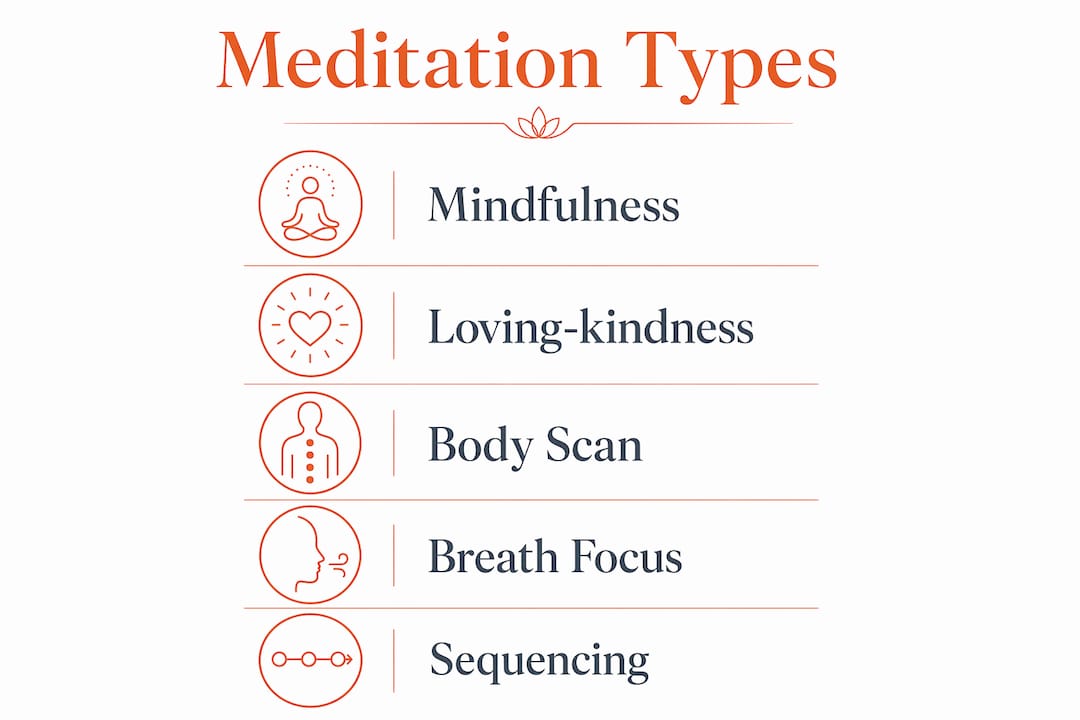
Mindfulness meditation
Mindfulness meditation uses breath focus or body scanning to anchor attention without demanding cognitive effort. Ten minutes of mindfulness can restore working memory capacity. That makes it the most practical starting point for people who are already depleted.
Loving-kindness meditation
Loving-kindness meditation directs attention toward positive emotional states. It interrupts ruminative patterns that consume cognitive resources without producing useful output. For people whose fatigue comes from interpersonal stress or emotional labor, this technique addresses the source directly.
Body scan meditation
Body scan meditation moves attention systematically through physical sensations. It is particularly effective for people who carry stress physically, such as tension in the shoulders or jaw. The scan grounds awareness in the body before asking the mind to do anything more demanding.
Why sequencing matters
Effective fatigue meditation sequences address three layers in order: sensory grounding, nervous system regulation, and mental focus. Jumping straight to breath focus when your nervous system is still in high-alert mode produces frustration, not recovery. The sequence matters because each layer prepares the next.
A practical three-step protocol looks like this:
- Grounding (2–3 minutes): Body scan or physical sensation focus to anchor you in the present
- Breath regulation (3–5 minutes): Slow, extended exhales to shift the nervous system toward parasympathetic state
- Anchor focus (5–10 minutes): Breath counting, a mantra, or soft visual focus to recalibrate attention
Pro Tip: For people in adaptive meditation techniques research, the body scan before breath work consistently outperforms breath work alone for fatigue relief.
The nervous system must shift to a parasympathetic state before high-focus meditation produces optimal results. Skipping the grounding step is the single most common reason people report that meditation “doesn’t work” for them.
How to meditate for energy: a step-by-step session
A restorative session does not require special equipment or a dedicated room. You need a quiet space, a timer, and a chair or floor where you can sit upright without effort.
Environment and posture
Sit with your spine supported but not rigid. Feet flat on the floor if you are in a chair. Hands resting on your thighs. Close your eyes or soften your gaze downward. The goal is a body position that requires zero muscular effort to maintain.
The session structure
Follow this sequence for a 10–15 minute restorative session:
- Set a timer for your chosen duration so you are not checking the clock
- Take three deep breaths, exhaling slowly and completely each time
- Scan your body from feet to head, noticing tension without trying to fix it
- Shift to breath focus, counting each exhale from 1 to 10, then starting again
- When your mind wanders, note it without judgment and return to the count
- In the final 2 minutes, release the count and simply notice the quality of your breath
- Before opening your eyes, take one slow breath and notice how your body feels
Timing your sessions
| Time of day | Why it works | Recommended length |
|---|---|---|
| Morning (before screens) | Sets parasympathetic baseline for the day | 10–15 minutes |
| Midday (12–2 pm) | Counteracts circadian alertness dip | 10–20 minutes |
| Late afternoon (4–5 pm) | Clears accumulated cortisol before evening | 5–10 minutes |
Scheduled midday meditation counteracts the natural circadian alertness dip, clears cortisol, and recalibrates attention for afternoon performance. That midday window is the highest-value slot for people who work long cognitive hours.
For people new to the practice, check out micro-meditation approaches that build the habit in under five minutes before extending session length.
Pro Tip: Start with 5 minutes daily for two weeks before extending to 10–20 minutes. Consistency builds the neural habit faster than occasional long sessions.
Common mistakes that block mental fatigue recovery
Most people who say meditation did not work for them made one of a small number of predictable errors. Identifying them is faster than trial and error.
Trying to stop thinking. The brain does not stop producing thoughts during meditation. The practice is noticing thoughts and returning to the anchor. Expecting silence creates frustration that raises cortisol rather than lowering it.
Skipping the grounding step. Jumping directly into breath focus when the nervous system is still activated produces restlessness. The body scan or physical grounding step is not optional for fatigued people. It is the prerequisite.
Sessions that are too long too soon. A 30-minute session for a beginner with high mental exhaustion often ends in sleep or frustration. Start shorter. A consistent 5-minute practice builds more neural adaptation than an occasional 30-minute session.
Practicing at the wrong time. Meditating immediately after intense cognitive work, without a brief physical break first, can extend the stress state rather than interrupt it. A short walk before sitting down improves outcomes.
Measuring success by how calm you feel. The goal of fatigue-focused meditation is restored attention capacity, not relaxation. You may finish a session feeling alert rather than sleepy. That is the correct result.
“Meditation for mental fatigue is not about achieving peace. It is about retraining the brain’s attention systems so they can sustain focus again. The feeling of energy after a session is the signal that it worked.”
Check the daily meditation routine best practices guide for a full breakdown of how to build consistency without burning out on the practice itself.
Key takeaways
Meditation relieves mental fatigue by recalibrating the prefrontal cortex, lowering cortisol, and restoring working memory through structured attention shifts, not passive rest.
| Point | Details |
|---|---|
| Session length matters | 10–20 minutes restores attentional performance; 3 minutes produces measurable cortisol reduction. |
| Sequence beats technique | Ground first, regulate breath second, then apply anchor focus for best fatigue recovery. |
| Timing is a variable | Midday sessions counteract the circadian dip and clear accumulated cortisol most effectively. |
| Anchors outperform emptiness | Exhausted minds recover faster with a breath count or body scan than with open awareness. |
| Consistency beats duration | Daily 5-minute sessions build neural adaptation faster than occasional long sessions. |
What I have learned from meditating through burnout
The most useful shift I made was stopping the search for calm and starting to measure energy instead. After a session, the question I ask is not “Do I feel relaxed?” but “Can I think clearly again?” Those are different outcomes, and only one of them tells you the practice is working.
The sequencing insight changed everything for me practically. I spent months doing breath focus immediately after intense work and wondering why I felt more agitated, not less. Adding a two-minute body scan before the breath work was the fix. The nervous system needs a transition, not a command.
I also stopped treating long sessions as the goal. Five focused minutes at midday, done consistently, produced more sustained energy than weekend meditation marathons. The brain adapts to what you repeat, not to what you do occasionally.
My honest advice: pick one technique, apply the three-step sequence, and do it at the same time every day for three weeks. Do not experiment with styles until you have a baseline. Variety is useful once the habit is stable. Before that, it is just another form of distraction.
The people who get the most from this practice are not the ones who meditate longest. They are the ones who meditate at the right moment, with the right sequence, and with realistic expectations about what recovery actually feels like.
— Giorgio
Mosaiic: guided sessions built around your energy, not just your calm
Mental fatigue is specific. A rough week at work is not the same as creative burnout or the fog that follows a personal loss. Generic audio tracks treat all of them the same way.

Mosaiic generates a personalized guided session each day based on what you describe as draining you. You tell it what is happening, and it writes and narrates a 5-minute meditation built around that context. Each session builds on the last, so the practice evolves as you do. The positioning is explicit: energy, not just calm. Mosaiic offers a Free tier with sample sessions, a Starter plan, and a Daily (Pro) plan for people who want a full daily practice. If you are ready to stop guessing which technique fits today, Mosaiic gives you one that does.
FAQ
How long should I meditate to relieve mental fatigue?
10–20 minute sessions restore attentional performance to pre-depletion levels. Even 3 minutes produces measurable cortisol reduction for people with limited time.
What is the best type of meditation for mental exhaustion?
Mindfulness meditation with breath focus or body scanning is the most effective starting point. Sequencing matters: ground first, regulate breath second, then apply a focus anchor.
Can meditation make mental fatigue worse?
Practicing without a grounding step or attempting sessions that are too long too soon can increase frustration. Start with 5 minutes and add the body scan before breath focus.
When is the best time of day to meditate for energy?
Midday, between 12 and 2 pm, is the highest-value window. It counteracts the natural circadian alertness dip and clears cortisol before the afternoon work period.
Does guided meditation work better than silent meditation for fatigue?
Guided meditation provides an external anchor, which is particularly useful for exhausted minds that struggle to self-direct attention. It is a practical starting point before building an independent practice.