How Meditation Addresses Demotivation: a 2026 Guide
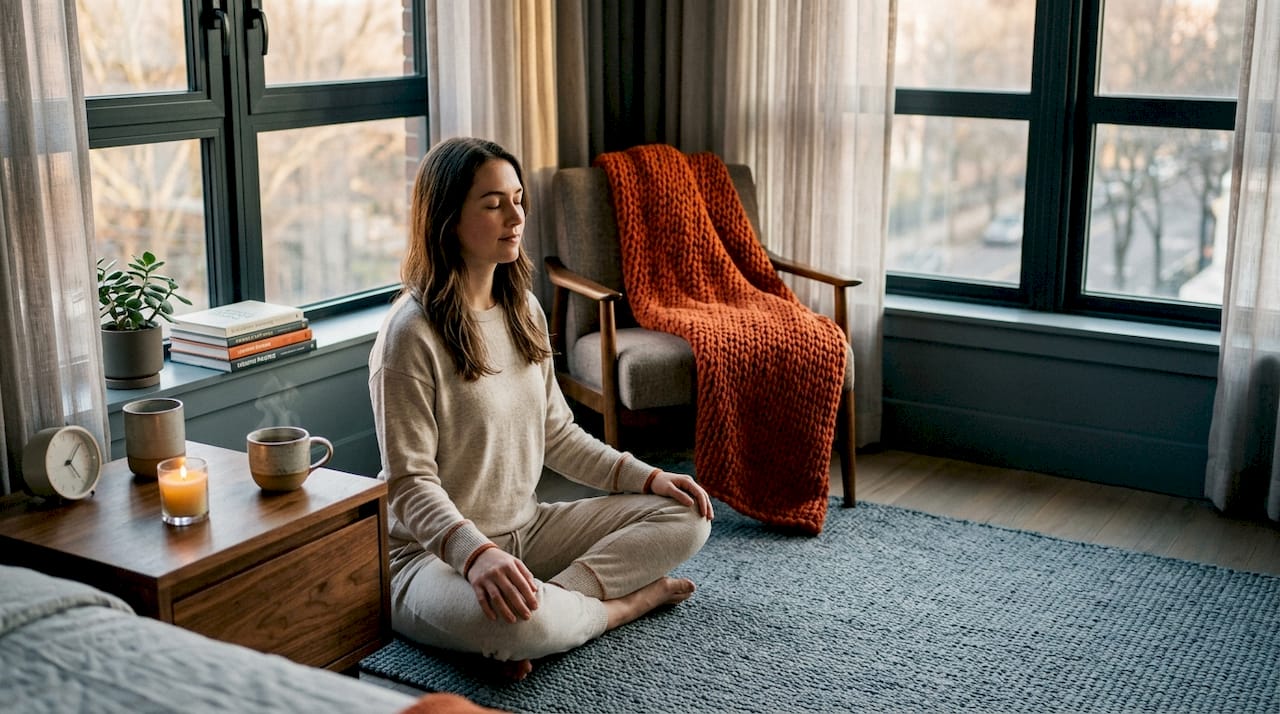
Meditation addresses demotivation by removing the cognitive and emotional barriers that block your ability to act, specifically stress, anxiety, and mind-wandering, rather than by injecting willpower from nowhere. Recent 2026 clinical trials confirm that practices like Mindfulness-Based Cognitive Therapy (MBCT), Loving-Kindness meditation, and SKT1 breathing meditation each target different roots of low motivation through measurable neurological and psychological mechanisms. This guide explains what the science actually shows, which style fits your situation, and how to build a practice that restores your energy without adding pressure.
How meditation addresses demotivation: what the science says
Meditation works on demotivation primarily through stress regulation, not inspiration. A 4-week study with 197 adults found that daily mindfulness and breathing improved goal progress by reducing perceived stress, not by directly increasing drive or willpower. That distinction matters. Demotivation is not a character flaw. It is often stress blocking the path between intention and action.
Anxiety and mind-wandering are two of the most reliable predictors of low motivation. A randomized controlled trial of 299 adults showed that 10 minutes of focused-attention meditation daily over 8 weeks reduced both anxiety and cognitive distraction through an 8-week follow-up period. That reduction in mental noise lowers what researchers call “task-start friction,” the internal resistance that makes starting anything feel harder than it should.

Mindfulness-Based Cognitive Therapy adds another layer. An RCT examining online MBCT found that mindfulness and cognitive defusion together explained up to 52% of the variance in depression severity scores, a key driver of demotivation. Cognitive defusion means learning to observe your thoughts without being controlled by them. When you stop treating “I have no energy” as a fact and start seeing it as a passing mental event, the grip it has on your behavior loosens.
For rapid mood relief, SKT1 breathing meditation stands out. University students practicing self-directed SKT1 sessions saw negative mood drop roughly 43% per session across 28 sessions. That is not a gradual effect. It is a session-by-session shift that compounds over weeks.
| Meditation type | Primary mechanism | Key outcome |
|---|---|---|
| Focused-attention (10 min/day) | Reduces anxiety and mind-wandering | Sustained cognitive improvement over 8 weeks |
| MBCT (mindfulness + cognitive defusion) | Breaks cognitive fusion with negative thoughts | Up to 52% variance in depression severity explained |
| SKT1 breathing meditation | Autonomic regulation, immediate mood shift | ~43% negative mood reduction per session |
| Mindfulness + breathing exercises | Stress reduction enabling goal pursuit | Improved goal progress in 4-week trial |
Pro Tip: If you are new to meditation, start with a focused-attention practice of 10 minutes rather than longer sessions. The research supports this duration as sufficient to produce measurable anxiety and mood benefits without overwhelming beginners.
Which meditation style works best for your type of demotivation?
Not all demotivation feels the same, and not all meditation styles address it the same way. Choosing the right approach based on your specific experience accelerates results.
Mindfulness meditation for rumination and overthinking
Mindfulness meditation trains non-judgmental awareness of the present moment. For people whose demotivation comes from rumination, replaying failures or catastrophizing about the future, this style directly interrupts the loop. By observing thoughts without engaging them, you reduce cognitive fusion, the tendency to treat mental commentary as objective reality. MBCT builds on this foundation specifically for people whose low motivation connects to depressive thinking patterns.
Loving-kindness meditation for self-criticism and emotional exhaustion
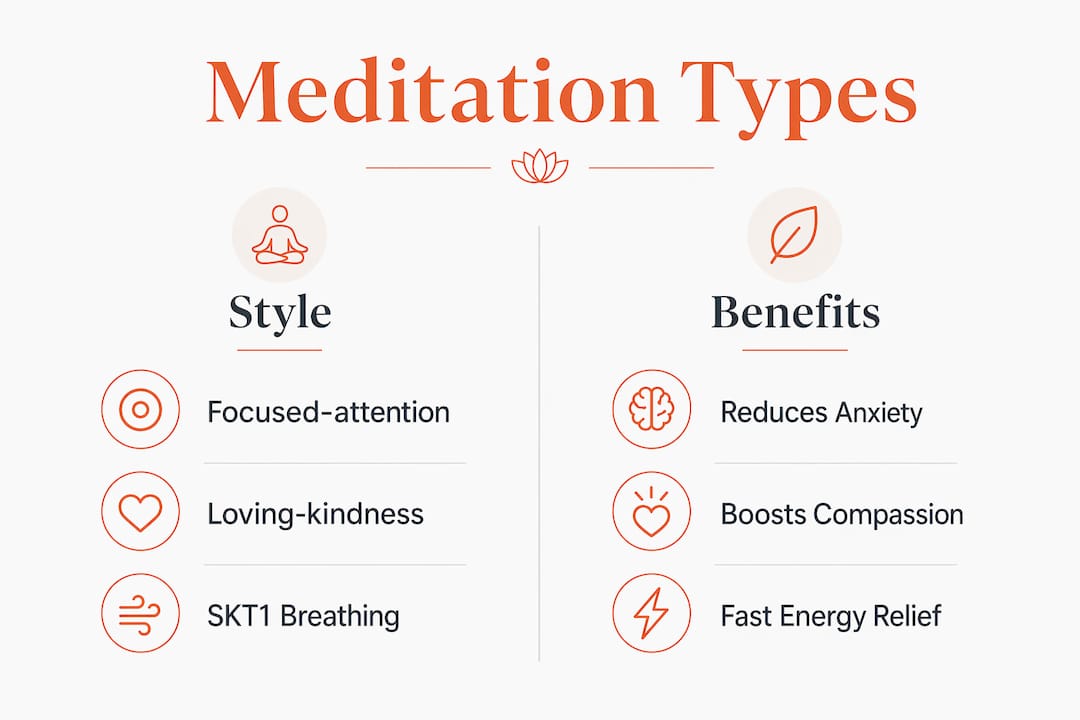
Loving-kindness meditation (also called Metta) directs compassion toward yourself and others through structured phrases and visualization. Long-term practitioners meditating 5 to 6 days per week showed lower anxiety through increased self-compassion and reduced cognitive fusion. This matters because self-criticism is one of the most common drivers of sustained demotivation. When you constantly judge yourself for not doing enough, the emotional cost of trying rises. Loving-kindness lowers that cost.
SKT1 breathing meditation for fast relief and energy restoration
SKT1 breathing meditation works through the autonomic nervous system. Controlled breathing patterns shift the body out of a stress-activated state, which directly affects mood and perceived energy. The immediate mood improvements documented in the SKT1 study make this style particularly useful when you need relief today, not after eight weeks of practice. It is also self-directed, meaning you do not need a teacher or group to benefit.
| Style | Core mechanism | Best for | Optimal frequency |
|---|---|---|---|
| Mindfulness / MBCT | Cognitive defusion, present-moment awareness | Rumination, overthinking, depressive patterns | Daily, 10 min minimum |
| Loving-kindness (Metta) | Self-compassion, emotional regulation | Self-criticism, emotional exhaustion | 5 to 6 days per week |
| SKT1 breathing meditation | Autonomic regulation, rapid mood shift | Immediate relief, low energy, stress spikes | Daily, each session as needed |
Pro Tip: If you are unsure which style to start with, pick the one that sounds least intimidating. Consistency matters more than perfection of technique. A loving-kindness session you actually complete beats a mindfulness session you skip because it feels too hard.
Can meditation ever reduce your motivation?
This is a real finding, and ignoring it would be dishonest. Some research reports that mindfulness meditation lowers task motivation even while leaving performance and work quality intact. That sounds contradictory until you understand what is actually happening.
Stress-driven urgency is not the same as genuine motivation. Many people operate on a constant background hum of anxiety that pushes them to act. When meditation reduces that anxiety, the frantic push disappears. Some people interpret this as losing motivation. What they have actually lost is the stress that was masquerading as drive.
Here is who is most likely to experience this effect:
- People whose productivity has historically been fueled by fear of failure or external pressure
- High achievers who have never separated their sense of self-worth from output
- Individuals in competitive environments where anxiety is normalized as ambition
- Beginners who mistake calm for disengagement
The practical implication is not to avoid meditation. It is to pair meditation with clear goal-setting so that when the stress-driven urgency fades, intentional direction replaces it. Meditation unblocks the path. You still need to decide where you are going.
If you notice reduced drive after starting a meditation practice, treat it as a signal to revisit your goals, not as a reason to stop meditating. The research shows performance does not suffer. The quality of your motivation changes from reactive to chosen.
Practical steps to use meditation for daily motivation and energy
Building a meditation practice that actually supports motivation requires a few specific decisions upfront. Here is what the evidence recommends.
Start with 10 minutes, 5 to 6 days per week. The 4-week goal-progress study used sessions of 6 to 12 minutes. The focused-attention RCT used 10 minutes daily. Neither required hour-long sessions. Longer is not better for beginners, and the pressure to do more often causes people to stop entirely.
Track task-start friction, not just mood. One of the clearest signs that meditation is working is that starting tasks becomes easier, even when you do not feel particularly energized. Keep a simple log: rate how hard it was to begin your first task each morning on a scale of 1 to 10. Over two to three weeks, you will likely see that number drop before you notice any dramatic mood shift.
Use self-compassion as a practice tool, not just a concept. Missing a day is not failure. The research on loving-kindness practitioners shows that excessive pressure to maintain a perfect streak can itself become demotivating. Aim for consistency over perfection. Five days of 10-minute sessions beats two days of 30-minute sessions followed by a week of guilt.
A quick-start routine for overcoming demotivation with meditation:
- Morning: 10-minute focused-attention or SKT1 breathing session before checking your phone
- Midday: 5-minute loving-kindness practice if self-criticism spikes after a difficult task
- Evening: 5-minute body scan or breathing exercise to prevent stress from carrying into the next day
- Weekly: Reflect on task-start friction scores and adjust your practice style if needed
Pro Tip: Apps that generate context-specific guided sessions, like Mosaiic, remove the decision fatigue of choosing a practice each day. When you are already demotivated, the last thing you need is another choice to make.
Finally, recognize when meditation is not enough. Persistent demotivation with symptoms like anhedonia, concentration difficulty, and helplessness warrants professional assessment. Meditation supports recovery from mild to moderate stress-related low motivation. It is not a substitute for clinical evaluation when symptoms are severe or prolonged.
Key takeaways
Meditation addresses demotivation by reducing stress, anxiety, and cognitive distraction, which unblocks goal pursuit rather than directly manufacturing willpower.
| Point | Details |
|---|---|
| Stress reduction is the core mechanism | Meditation improves goal progress by lowering perceived stress, not by boosting willpower directly. |
| Match style to your symptoms | Use mindfulness for rumination, loving-kindness for self-criticism, and SKT1 breathing for immediate relief. |
| 10 minutes is enough to start | Research supports 10-minute daily sessions as sufficient for measurable anxiety and mood improvements. |
| Reduced drive can be a sign of progress | Meditation may lower stress-driven urgency; pair it with intentional goal-setting to maintain direction. |
| Know when to seek professional help | Persistent demotivation with depression-like symptoms requires clinical assessment, not just meditation. |
What I actually think about meditation and motivation
People talk about motivation as if it is a resource you either have or you do not. That framing is the problem. In my experience, most demotivation is not an absence of desire. It is the presence of too much noise, too much self-judgment, and too much accumulated stress that makes the gap between wanting to act and actually acting feel uncrossable.
The research on MBSR is striking to me for a specific reason. MBSR produces anxiety reductions comparable to escitalopram, a common anxiety medication, with roughly 15% side effects versus 80% in the medication group. That is not a minor finding. It means meditation is not a soft alternative. It is a clinically serious tool that most people underuse because it does not feel like doing something.
The misconception I see most often is that meditation is passive. People think sitting quietly is the opposite of getting things done. The evidence says otherwise. Reducing mind-wandering and anxiety is exactly what creates the mental space to act. You are not resting. You are clearing the path.
My honest caution: do not use meditation as a way to avoid confronting what is actually draining you. If your job is genuinely wrong for you, or a relationship is depleting your energy, meditation will help you tolerate the situation more calmly. That is not the same as solving it. Use the clarity that meditation creates to make better decisions, not just to feel better about difficult ones.
Technology-assisted meditation, particularly apps that adapt to your specific context, is where I see the most practical potential for people who are already stretched thin. The barrier to starting is lower, and the personalization means you are not doing a generic relaxation session when what you actually need is help with a specific kind of exhaustion.
— Giorgio
Rebuild your motivation with Mosaiic
If you have read this far, you are not looking for generic relaxation. You want something that actually addresses what is draining you.
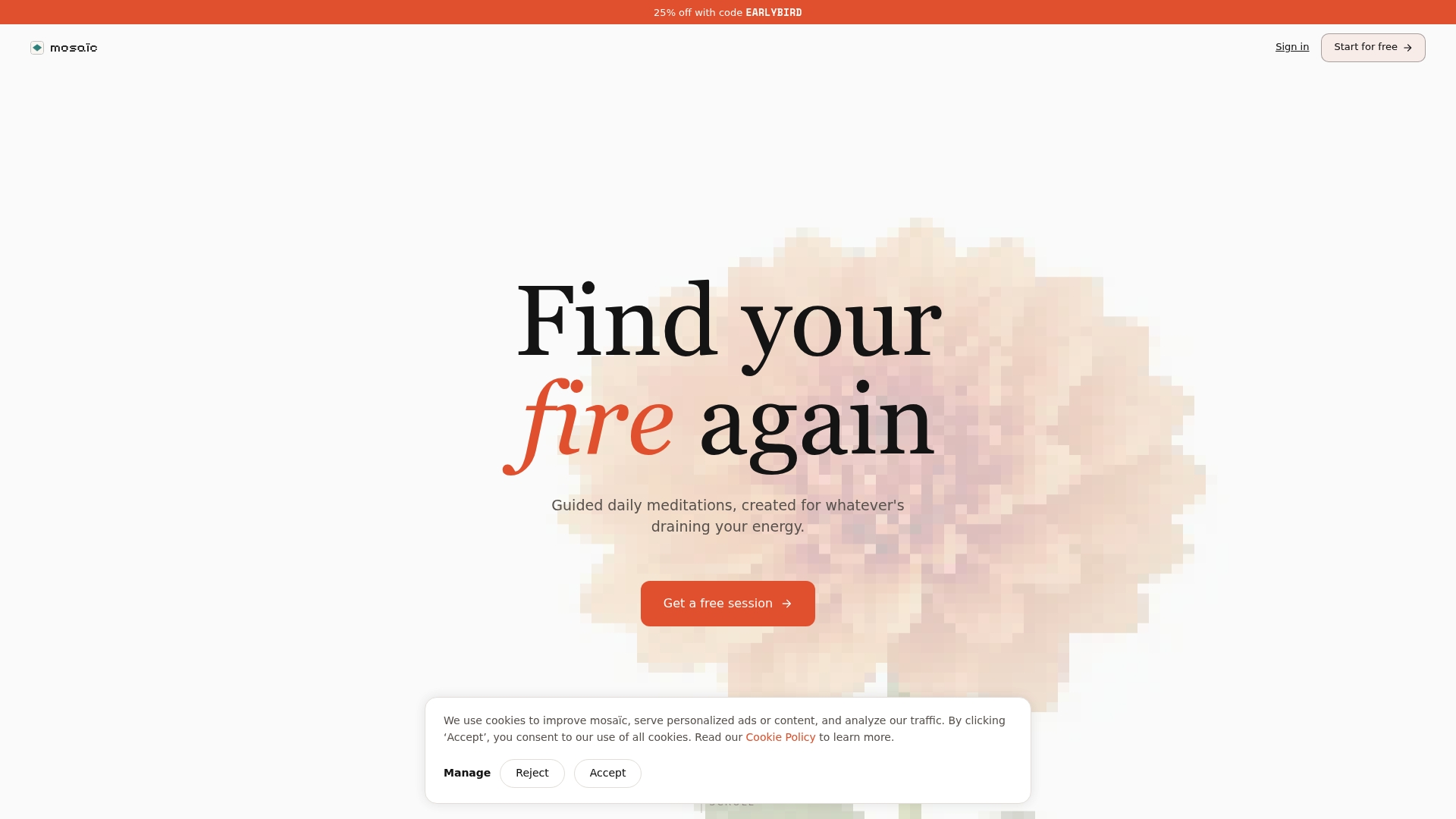
Mosaiic is a personalized meditation app built around exactly that premise. You describe what is going on, burnout, a rough stretch, a loss of direction, and Mosaiic writes and narrates a 5-minute guided session specific to your situation. Each session builds on the last, so the practice evolves as you do. The positioning is deliberate: energy, not just calm. You finish a session feeling fuller, not sleepier. Mosaiic offers a Free tier with sample sessions, a Starter plan, and a Daily (Pro) plan for those who want a full practice. If you are ready to find your motivation again, Mosaiic is built for exactly where you are right now.
FAQ
How does meditation help with lack of motivation?
Meditation reduces the stress, anxiety, and mind-wandering that block goal pursuit. Research shows that daily meditation practice improves goal progress primarily by lowering perceived stress rather than directly increasing drive.
How long does it take for meditation to improve motivation?
Studies show mood improvements can occur within a single SKT1 breathing session, while broader anxiety and cognitive benefits build over 4 to 8 weeks of consistent daily practice of around 10 minutes.
Does meditation help with lack of motivation caused by depression?
MBCT is specifically designed for this overlap. It reduces depressive symptoms through mindfulness and cognitive defusion, explaining up to 52% of variance in depression severity. Persistent or severe symptoms still require professional assessment.
Can meditation make motivation worse?
Some research finds that mindfulness temporarily lowers task motivation while leaving performance intact. This reflects a shift from stress-driven urgency to calmer, more intentional motivation, not a net loss of capability.
How often should I meditate to see motivation benefits?
The research supports 5 to 6 days per week as the optimal frequency for anxiety and motivation benefits, particularly for loving-kindness meditation. Consistency matters more than session length for long-term results.