Why Five-Minute Meditations Work: Science Explained

Five-minute meditations work because the brain begins measurable neurophysiological changes within 2–3 minutes of starting a session. You do not need a retreat, a cushion, or 45 minutes of silence. Brief, consistent practice produces real stress relief, sharper focus, and lower cortisol. The science behind short meditation has advanced significantly, and 2026 research confirms what practitioners have long suspected: duration matters far less than most people assume.
Why five-minute meditations work, according to neuroscience
The brain does not need a long runway to shift states. Brainwave changes begin within about 2–3 minutes of starting meditation and peak around the 7-minute mark. That finding comes from a 128-channel EEG study tracking 103 participants across skill levels. The result holds for complete beginners, not just experienced practitioners.
Two specific brainwave types drive this shift: theta waves, associated with deep relaxation and creativity, and beta1 waves, linked to calm, focused attention. When these patterns emerge, your nervous system is actively reorganizing. The shift is not subjective. It shows up on electrodes.
“The five-minute window reflects rapid reorganization of brain states leading to calm focus, making brief meditations immediately effective.” — Psychology Today
The first 1–2 minutes of any session function as an onboarding phase. Your attention is still settling, and your mind may wander. That is normal and does not cancel the benefit. Novice meditators show measurable brainwave changes even when they report feeling distracted. The brain is doing the work whether or not you feel it happening.
Pro Tip: Do not judge the first two minutes of a session. Treat them as loading time, not failure. The neurological effect curve is still rising when you hit minute five.
This is the core reason why short meditation is effective: you are catching the brain mid-shift. Stopping at five minutes does not cut the session short. It captures the steepest part of the effect curve.
How do five-minute meditations reduce stress and improve well-being?
Brief meditation lowers cortisol, the body’s primary stress hormone, and regulates the HPA axis, which controls your stress response system. The Cleveland Clinic confirms that short daily meditation reduces stress, supports emotional regulation, and improves sleep and blood pressure. These are not minor quality-of-life perks. They are measurable physiological changes.
The mechanisms are straightforward. Breathwork activates the parasympathetic nervous system, slowing heart rate and signaling safety to the brain. Visualization techniques redirect attentional resources away from threat-processing circuits. Both techniques work quickly, which is exactly why five-minute sessions can deliver a genuine mental reset.
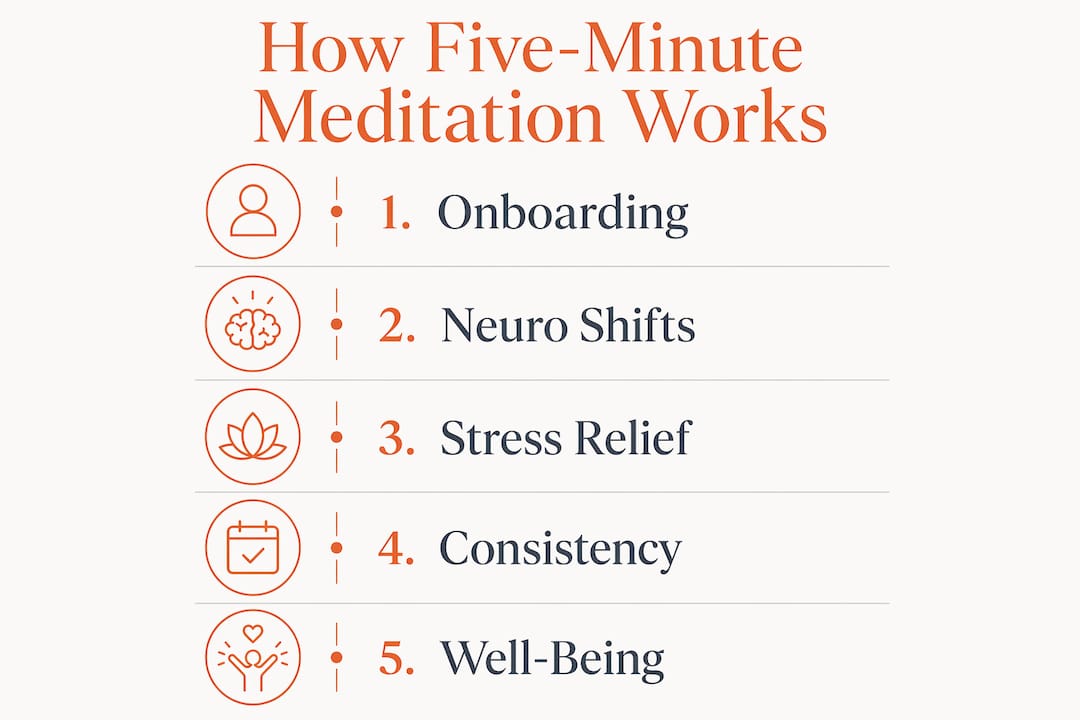
Clinical research backs this up. A randomized controlled trial with 299 meditation-naïve adults found that an ultra-brief daily meditation practice of at least 10 minutes per day over 8 weeks significantly reduced anxiety and mind wandering. The effects held at follow-up. That result matters because it shows psychological benefits do not require long sessions. They require consistency.
The benefits of short meditations extend further than stress alone:
- Anxiety reduction: Regular brief practice lowers baseline anxiety levels over weeks, not months.
- Sleep quality: Meditation reduces pre-sleep arousal, making it easier to fall and stay asleep.
- Mood stability: Even a single five-minute session can shift emotional tone within the hour.
- Blood pressure: Consistent practice is linked to measurable reductions in resting blood pressure.
- Emotional regulation: Regular meditators handle difficult emotions with less reactivity over time.
Each of these effects of brief meditation compounds. One session gives you a reset. Thirty sessions give you a different baseline.
Is consistency or session length more important for meditation benefits?

Consistency wins. Meditating 4–7 days per week produces stronger mood improvements and resilience gains than occasional long sessions. This is especially true for beginners. The nervous system learns through repetition, not intensity.
The comparison below shows how session frequency and length interact for new practitioners:
| Approach | Frequency | Typical outcome |
|---|---|---|
| Short sessions, daily | 5–10 min, 5–7 days/week | Strong mood gains, lower anxiety, sustainable habit |
| Long sessions, occasional | 20–45 min, 1–2 days/week | Deeper relaxation per session, weaker cumulative effect |
| Short sessions, sporadic | 5–10 min, 1–2 days/week | Minimal lasting benefit, habit rarely forms |
| Long sessions, daily | 20–45 min, 5–7 days/week | High benefit, but low adherence for most busy people |
The data is clear. A five-minute session you actually do beats a 30-minute session you keep postponing. Psychology Today reports that beginners doing 5–10 minute sessions showed mood improvements early in practice. The psychological benefits appear quickly and accumulate with each additional session.
Pro Tip: Treat your meditation practice like brushing your teeth. The goal is not a perfect session. The goal is showing up every day. Five imperfect minutes beats zero perfect ones.
The practical implication is direct. If you are choosing between a longer session three times a week and a five-minute session every day, choose every day. Frequency builds the neural habit. Length deepens it later, once the habit is already established.
How can you integrate five-minute meditations into daily life?
The biggest obstacle to meditation is not time. It is friction. Reducing friction means attaching your practice to something that already happens every day.
Follow this sequence to build a sustainable short meditation habit:
- Choose a trigger. Pick a recurring daily event: before your first meeting, after your morning coffee, or during your commute. Tying meditation to specific triggers strengthens the nervous system’s response over time. The trigger becomes the cue that primes your brain for the shift.
- Use the onboarding phase intentionally. Spend the first 60–90 seconds simply noticing your breath without trying to control it. This is the settling phase. Do not rush past it.
- Pick one technique per session. Breathwork (box breathing or 4-7-8 breathing) works well for acute stress. Body scan techniques work better for fatigue. Visualization suits pre-performance anxiety. Mixing techniques in a single five-minute session dilutes the effect.
- Track your sessions. Meditation session tracking shows you patterns in your practice and reinforces the habit loop. Wearable devices and apps can confirm physiological changes, which motivates continued practice.
- Adjust length as you progress. Start at five minutes. After 3–4 weeks of daily practice, extend to 7–10 minutes if it feels natural. The daily meditation best practices that work long-term are the ones you build gradually, not the ones you force from day one.
Quick meditation techniques like breathwork and visualization do not require silence or a special environment. You can practice them at your desk, in a parked car, or in a bathroom before a stressful conversation. The location matters far less than the consistency.
Key Takeaways
Five-minute meditations work because the brain reorganizes into a calmer, more focused state within minutes, and daily repetition compounds those effects into lasting stress relief and emotional resilience.
| Point | Details |
|---|---|
| Brain changes start fast | EEG research shows measurable brainwave shifts begin within 2–3 minutes, even in beginners. |
| Consistency beats length | Meditating 4–7 days per week produces stronger benefits than occasional long sessions. |
| Cortisol drops quickly | Short daily practice lowers stress hormones and supports sleep, mood, and blood pressure. |
| Onboarding phase is normal | The first 1–2 minutes are settling time, not failure. The effect curve is still rising. |
| Triggers build the habit | Attaching meditation to a daily cue trains the nervous system more effectively than willpower alone. |
What I have learned from five minutes a day
People assume meditation requires stillness, silence, and a cleared schedule. That assumption keeps most of them from ever starting. What I have found, both personally and from watching others build this habit, is that the first two minutes of any session feel like nothing is happening. Your mind is loud. You feel like you are doing it wrong. You are not.
The neuroscience confirms what practitioners have known for years: the brain is already shifting during those uncomfortable early minutes. You just cannot feel it yet. The discomfort is not a sign of failure. It is the onboarding phase doing its job.
The other thing most articles get wrong is the emphasis on length. Longer is not better for beginners. More frequent is better. A person who meditates for five minutes every morning for a month will outperform someone who does a 30-minute session once a week, in terms of mood, stress resilience, and habit formation. The compounding effect of daily practice is real, and it starts sooner than most people expect.
My honest advice: do not wait until you have time for a “real” meditation. Five minutes is real. It is enough. Start there, stay consistent, and let the length grow on its own when it feels right.
— Giorgio
Mosaiic: personalized five-minute sessions built for your energy
If you have been putting off meditation because generic sessions feel irrelevant to what you are actually dealing with, Mosaiic takes a different approach.
Mosaiic is a personalized meditation app that generates daily guided five-minute sessions based on what is draining your energy right now. You describe your situation, whether that is burnout, low motivation, or a rough week, and the app writes and narrates a session specific to that context. Each session builds on the last, so your practice evolves as you do. The positioning is explicit: energy, not just calm. Mosaiic is designed to leave you fuller, not sleepier. Three tiers are available: Free, Starter, and Daily (Pro). Find your fire again at Mosaiic.xyz.
FAQ
Why do five-minute meditations work so quickly?
Brainwave changes begin within 2–3 minutes of starting meditation, according to EEG research tracking 103 participants. The brain reorganizes into a calmer, more focused state faster than most people expect.
Is five minutes of meditation enough to reduce stress?
Yes. The Cleveland Clinic confirms that short daily meditation lowers cortisol and supports emotional regulation. A randomized controlled trial also showed that brief daily practice significantly reduced anxiety over 8 weeks.
Does mind wandering during meditation cancel the benefits?
No. EEG data shows that novice meditators produce measurable brainwave changes even when they report feeling distracted. The neurological effect happens regardless of subjective experience.
How often should I meditate to see real results?
Meditating 4–7 days per week produces stronger mood and resilience gains than occasional longer sessions. Frequency matters more than session length, especially for beginners.
What are the best quick meditation techniques for beginners?
Box breathing and 4-7-8 breathwork are the most accessible quick meditation techniques. Both activate the parasympathetic nervous system within minutes and require no prior experience or special environment.