How Meditation Tracks Emotional Progress in 2026

Emotional progress tracking through meditation is defined as the practice of quantifying emotional states using self-report, observation, and contextual tagging before and after each session. This process transforms vague feelings into measurable patterns over time. Research now confirms that measurable brain changes appear after as few as 7 days of intensive practice, giving practitioners real evidence of internal shifts. Understanding how meditation tracks emotional progress means recognizing that emotional valence, intensity scales, and contextual data are the core metrics, not just a sense of calm.
How does meditation track emotional progress?
Meditation tracks emotional progress by capturing three core data points: valence, intensity, and context. Valence describes the positive or negative tone of an emotion. Intensity measures how strong that emotion feels, typically on a 0–10 distress scale. Context records what triggered the emotion or what was happening in life at the time. Together, these three inputs convert a subjective inner experience into a pattern you can actually read.

The two main methods for capturing this data are minimalist tagging and reflective journaling. Minimalist tagging means writing a single word or short phrase plus a number immediately before and after a session. For example: “anxious, 7” before a session and “calm, 3” after. Journaling goes deeper, capturing narrative detail about emotional triggers and recovery. Both methods work, but short labels improve consistency over time more reliably than lengthy entries.
Pre and post-session reflections are the most underused tool in emotional tracking. Most people rate their mood only after a session, missing the contrast that reveals real change. Logging both before and after creates a delta, a measurable gap that shows whether the session moved the needle. Over weeks, those deltas stack into a visible trend.
Pro Tip: Use a single word plus a number (e.g., “frustrated, 8”) as your pre-session tag. It takes under five seconds and produces cleaner pattern data than a paragraph of journaling.
What does the science say about meditation and emotional regulation?
The scientific case for meditation’s effect on emotional regulation is strong and growing. A 7-day intensive program produced measurable improvements in brain connectivity and natural pain relief. That speed of change matters. It means practitioners do not need months before their tracking data starts showing real shifts.
Longer programs produce deeper results. An 8-week mindfulness intervention reduced rumination and anxiety in a randomized controlled trial, with benefits persisting for days after each session. Reduced rumination is especially significant for emotional tracking because rumination distorts self-assessment. When you ruminate less, your pre-session emotional ratings become more accurate, which makes your tracking data more reliable.
The table below summarizes key study outcomes and what they mean for practitioners tracking their own emotional growth.
| Study type | Duration | Key outcome | Tracking implication |
|---|---|---|---|
| Brain imaging study | 7 days | Improved brain connectivity | Early data shifts visible within first week |
| Randomized controlled trial | 8 weeks | Reduced rumination and anxiety | More accurate self-ratings over time |
| Mindfulness intervention | Ongoing | Lasting stress reduction between sessions | Progress visible across days, not just sessions |
| Emotional regulation research | Long-term | Increased tolerance for discomfort | Intensity scores trend downward over months |
“The benefits of mindfulness meditation go far beyond relaxation. Practitioners develop the capacity to hold uncomfortable feelings until those feelings become manageable.” — The Conversation
This shift from avoidance to tolerance is what emotional tracking actually measures. When your intensity scores for difficult emotions drop over months, that is not because the emotions stopped appearing. It is because your capacity to hold them grew.
How does technology improve emotional tracking in meditation?
Emotion AI now adds an objective layer to what was previously a fully subjective process. These tools analyze facial expressions, voice tone, and language patterns to gauge emotional states before, during, and after meditation. Emotion AI captures subtle arousal markers and recovery speed that self-report alone often misses. A person might rate their stress as a 4 out of 10 while their vocal tone signals significantly higher tension.
The gap between self-reported and physiologically detected emotion is one of the most useful data points in modern emotional tracking. It reveals blind spots in self-awareness. Over time, as meditation practice deepens, that gap tends to narrow. Practitioners become better at reading their own internal states accurately. This convergence is itself a measurable sign of emotional growth.
Technology-augmented tracking also surfaces early warning signs. Aggregated session data can show rising stress trends before a person consciously registers them. That early signal gives practitioners a chance to adjust their practice, choosing techniques focused on grounding or regulation rather than general relaxation.
| Tracking method | Strengths | Limitations |
|---|---|---|
| Manual tagging | Fast, low friction, builds habit | Relies on accurate self-perception |
| Reflective journaling | Rich context, captures nuance | Time-intensive, harder to sustain |
| Emotion AI analysis | Objective, detects subtle signals | Requires device and setup |
| Combined approach | Most complete picture | Needs consistent use across both methods |
Pro Tip: Use technology data to check your self-ratings, not replace them. When your app shows high stress markers but you rated yourself a 3, that discrepancy is worth exploring in your next session.
Apps like Mosaiic take a context-first approach. You describe what is draining your energy, and the app generates a session built around that specific situation. Each session builds on the last, so the progression of sessions reflects your actual emotional state rather than a generic program.
What practical methods help you track emotional growth at home?
Tracking emotional growth does not require clinical tools or expensive technology. A consistent, simple system produces reliable data over time. The following steps work for most people starting from scratch.
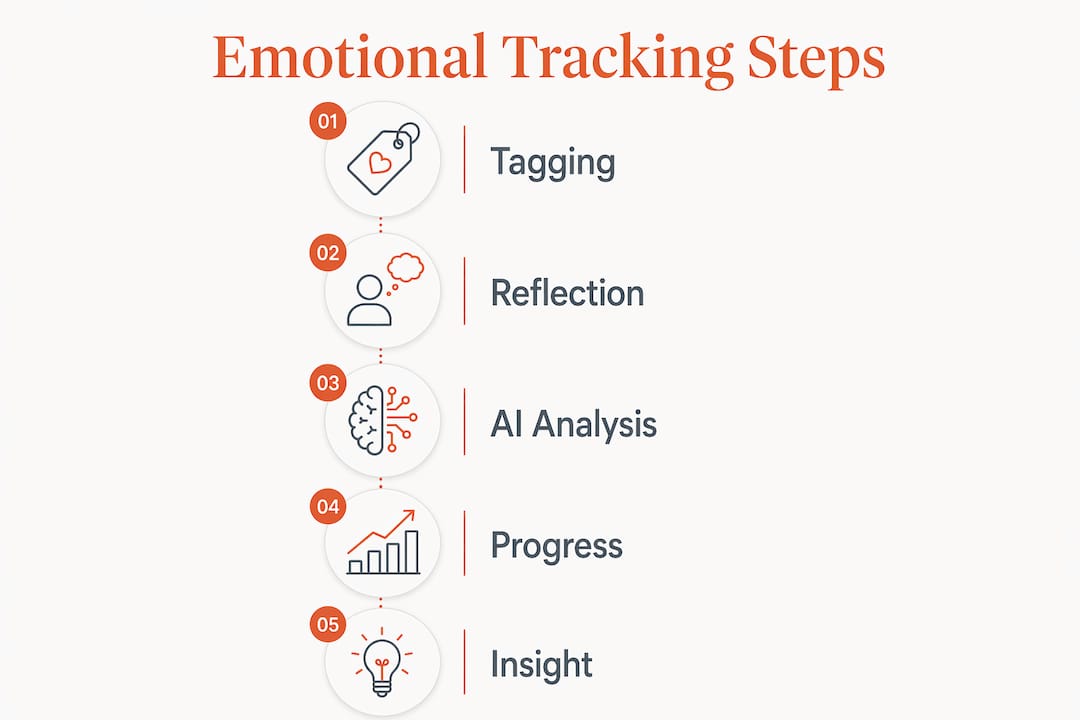
- Set a session intention. Before you begin, write one sentence about what you want to address. “I want to lower the tension I feel about work” is a useful intention. “I want to feel better” is too vague to track.
- Tag your emotion before the session. One word plus an intensity score on a 0–10 scale. Write it down or type it into a notes app.
- Tag your emotion immediately after. Same format. Do not wait. Emotional states shift quickly after a session ends.
- Note any triggers or context. One sentence maximum. “Had a difficult conversation before this session” is enough.
- Review your tags weekly. Look for patterns across five or more sessions. Are your pre-session scores trending higher? Are your post-session drops getting larger?
Tracking discrepancies between your intended focus and your actual emotional outcome is one of the most revealing practices in this process. If you set an intention around anxiety but consistently end sessions feeling more irritable than calm, that pattern points to a technique mismatch, not a personal failure.
Common patterns to watch for include plateaus, where scores stay flat for two to three weeks before a sudden drop, and gradual improvement phases, where intensity scores decrease by one or two points per week. Both are normal. Plateaus often precede breakthroughs.
Common pitfalls to avoid:
- Skipping pre-session tags and only logging post-session feelings
- Using vague labels like “bad” or “fine” instead of specific emotion words
- Reviewing data daily instead of weekly, which amplifies noise over signal
- Treating a high intensity score as failure rather than useful information
- Abandoning tracking during high-stress periods, which are exactly when data is most valuable
How does tracking emotional progress build long-term mental well-being?
Tracking emotional progress builds mental well-being by developing emotional regulation capacity over time. Emotional regulation improves not by avoiding negative emotions but by learning to hold uncomfortable feelings until they become manageable. Tracking makes that growth visible. When you see your intensity scores for anger or grief trending downward across three months, you have concrete evidence that your capacity has grown.
Consistent tracking also builds self-awareness in a specific, practical way. You begin to notice which situations reliably spike your pre-session scores. You learn which techniques bring your scores down most effectively. That knowledge lets you personalize your practice rather than following a generic program. Tracking multiple indicators together, including distress, physical sensations, and belief strength, reveals a fuller picture than any single metric alone.
The psychological benefits extend beyond the meditation session itself. People who track their emotional states report increased acceptance of difficult feelings and a stronger sense of agency over their mental health. Reduced loneliness is another documented benefit, partly because tracking creates a structured relationship with your own inner life. That relationship, built session by session, is the foundation of lasting emotional balance.
Key Takeaways
Meditation tracks emotional progress by converting subjective feelings into measurable data through valence, intensity, and context tagging, revealing real growth in emotional regulation over weeks and months.
| Point | Details |
|---|---|
| Core tracking metrics | Log emotional valence, intensity (0–10), and context before and after every session. |
| Science supports early results | Brain changes appear after just 7 days of intensive practice, making early tracking data meaningful. |
| Discrepancy tracking reveals growth | Comparing intended focus with actual outcomes identifies which techniques produce real emotional shifts. |
| Technology adds objectivity | Emotion AI detects subtle stress signals that self-report alone often misses. |
| Tracking builds regulation, not elimination | Progress shows as lower intensity scores for difficult emotions, not their disappearance. |
Why I think most meditators are measuring the wrong thing
Most people judge their meditation by how calm they feel when the session ends. That is the wrong metric. Calm is a byproduct. What you are actually building is tolerance, the ability to stay present with discomfort without being controlled by it. If you only track post-session calm, you will miss the real progress entirely.
I have seen this pattern repeatedly. Someone practices for six weeks, feels frustrated that they still get anxious, and concludes meditation is not working. But their pre-session anxiety scores have dropped from 8 to 5. Their recovery time after a difficult emotion has shortened from hours to minutes. The progress is real. They just were not measuring it.
The other mistake is treating tracking as judgment. A high intensity score before a session is not evidence that you are failing. It is evidence that you showed up on a hard day. That is exactly the data you need. The days when you feel worst and still practice are the days that move your long-term scores the most.
Combining subjective tags with objective data, whether from an app like Mosaiic or a simple daily check-in practice, gives you both the numbers and the meaning behind them. Neither alone is enough. The numbers without context feel clinical. The context without numbers stays vague. Together, they give you something you can actually act on.
— Giorgio
Mosaiic and the path to measurable emotional growth
Tracking your emotional progress works best when your meditation sessions are built around what you are actually feeling, not a generic script.

Mosaiic generates daily guided sessions based on what is draining your energy right now. You describe your situation, and the app writes and narrates a 5-minute session specific to that context. Each session builds on the last, so your practice evolves as your emotional state does. The user input approach means your tracking data and your sessions stay connected. Mosaiic offers a Free tier with sample sessions, plus Starter and Daily (Pro) plans for deeper practice. Visit mosaiic.xyz to start a practice that grows with you.
FAQ
How does meditation track emotional progress over time?
Meditation tracks emotional progress by capturing emotional valence, intensity scores, and context before and after each session. Reviewing these data points weekly reveals trends in emotional regulation capacity over weeks and months.
Does meditation help with difficult feelings or just reduce stress?
Meditation builds the capacity to hold uncomfortable feelings until they become manageable, rather than eliminating them. Research shows this tolerance-building is the primary mechanism behind lasting emotional improvement.
How long does it take to see measurable emotional changes from meditation?
Brain connectivity improvements appear after as few as 7 days of intensive practice. Meaningful reductions in rumination and anxiety are documented after 8-week mindfulness programs.
What is the best way to measure emotional well-being during meditation?
Logging a single emotion word plus a 0–10 intensity score immediately before and after each session produces the most consistent and usable data for tracking emotional growth.
Can a meditation app help track emotional progress accurately?
Apps that adapt sessions to your described emotional state, like Mosaiic, connect your tracking data directly to your practice. This makes it easier to spot which techniques produce real emotional shifts over time.