The Role of Daily Check-Ins in Meditation Practice
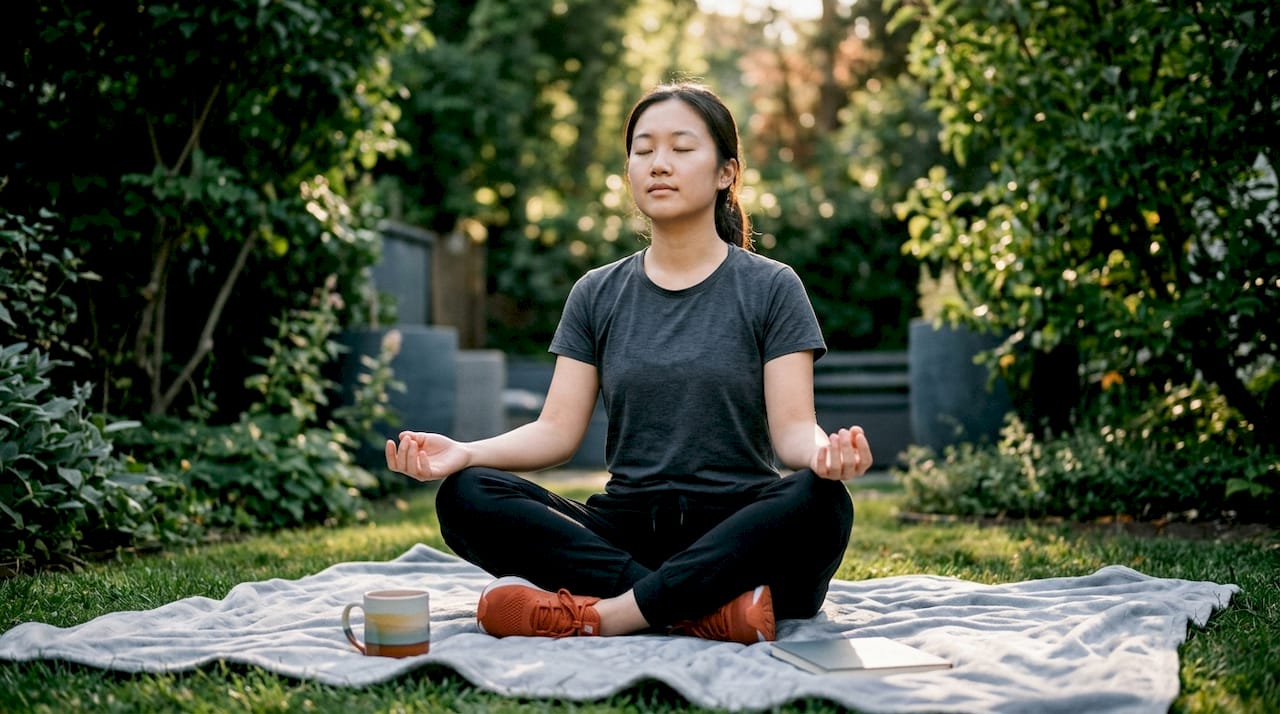
A daily meditation check-in is a brief, intentional pause to observe your current mental state, emotional tone, and physical sensations before, during, or after a formal session. The role of daily check-ins in meditation goes well beyond simple relaxation. They train your brain to notice what is happening inside you without immediately reacting to it. That single shift, from reacting to noticing, is where real mindfulness growth happens. Tools like meditation apps, guided audio, and journaling all support this process, but the core practice is the pause itself.
What does the evidence say about daily meditation check-ins?
The science behind regular mindfulness practice is more flexible than most people expect. Even 5 minutes every other day produces meaningful mental health improvements in controlled trials. That finding matters because it removes the all-or-nothing pressure that causes most people to quit.
Short sessions also carry more weight than their length suggests. Sessions as brief as 4 minutes reduce rumination and improve self-compassion for two to four days after practice. A four-minute check-in on a Tuesday morning can still be shaping how you handle a stressful meeting on Thursday.
“The real value of daily check-ins is choosing to pause and stay with experiences, training balance over reactivity.” This is the core mechanism that separates mindfulness from ordinary relaxation.
Research from eight-week randomized controlled trials confirms that frequency matters more than session length. Participants who checked in consistently, even briefly, showed measurable reductions in cognitive interference and self-preoccupation. Consistency builds the neural habit of pausing. Length refines it.
The benefits of daily meditation extend to self-compassion as well. Practitioners who check in regularly report softer internal responses to their own mistakes and setbacks. That shift is not automatic. It is the direct result of repeatedly choosing to observe rather than judge.
How do daily check-ins improve emotional regulation?
Meditation’s core benefit comes from training acceptance, not from achieving a calm state. This distinction changes how you approach every session. You are not trying to feel good. You are practicing the skill of staying present with whatever is actually there.
The human brain carries a built-in negativity bias. It registers threats faster and holds them longer than positive experiences. Daily check-ins act as active retraining. Each time you pause and notice a difficult feeling without amplifying it, you weaken the automatic grip of that bias.
Buddhist psychology describes the “second arrow” as the suffering you add on top of an original pain. You stub your toe (first arrow), then spend ten minutes angry at yourself for not watching where you were going (second arrow). Brief daily check-ins reduce this second-arrow reaction by training you to meet difficult feelings as temporary guests rather than permanent residents.
Here is what that looks like in practice:
- Notice early: Catch the first sign of stress, tightness in your chest, a racing thought, before it escalates.
- Name it without judgment: “There is anxiety here” rather than “I am anxious and that is bad.”
- Return without force: Gently redirect attention to breath or body, the same way you would guide a child away from danger.
- Observe the shift: Watch how the feeling changes when you stop fighting it.
Pro Tip: Set a single daily alarm labeled “check-in” for a time you already pause naturally, like after your first coffee or before lunch. Attaching the habit to an existing anchor removes the friction of remembering.
Structured check-ins vs. informal mindfulness moments
Not all check-ins look the same, and understanding the difference helps you use both more effectively.
| Feature | Structured check-in | Informal mindfulness moment |
|---|---|---|
| Timing | Scheduled, consistent time | Spontaneous, triggered by context |
| Duration | 3–10 minutes | 10–60 seconds |
| Format | Guided or journaled, follows a framework | Unscripted, intuitive |
| Primary benefit | Tracks progress, builds depth | Maintains presence throughout the day |
| Best used for | Measuring growth over weeks | Managing stress in real time |
Structured check-ins follow a deliberate framework. Seven specific check-in points cover baseline state, arrival quality, drift-and-return frequency, embodiment, emotional tone, daily carryover, and reflection quality. Working through these consistently reveals genuine progress in mindfulness capacity rather than just how good a single session felt.
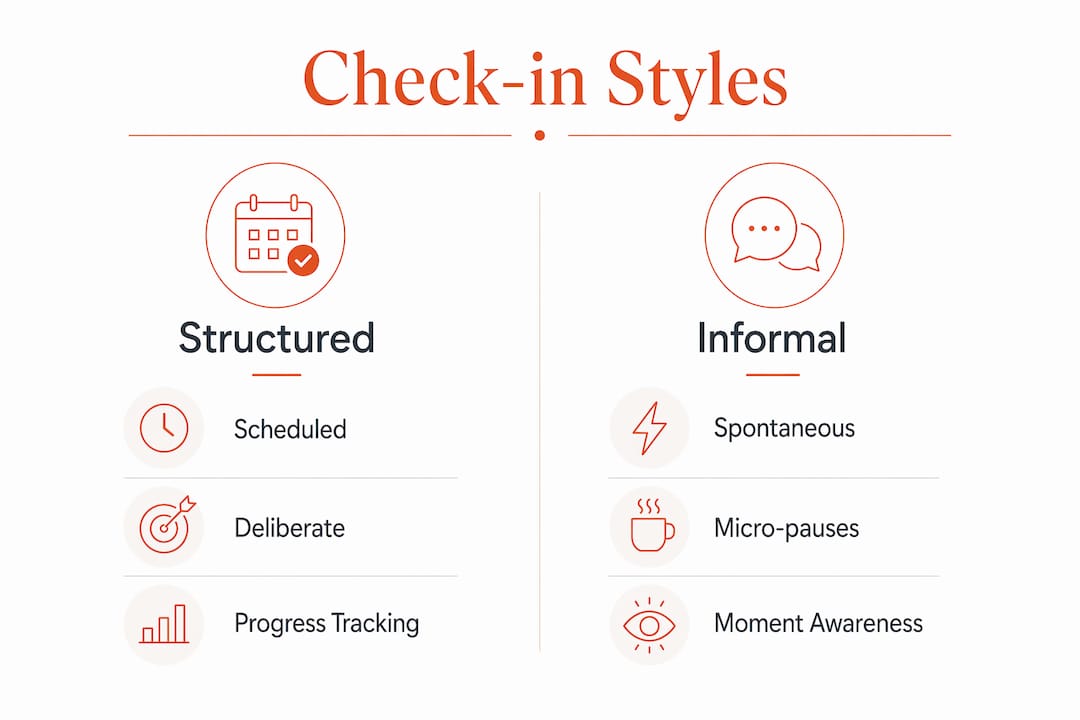
Informal mindfulness moments are the micro-pauses you take between meetings, at a red light, or while waiting for water to boil. These brief pauses support emotional regulation and keep you grounded across the full day, not just during formal practice. They are not a replacement for structured sessions. They are the application layer.
The two approaches work together. Structured check-ins build the skill. Informal moments deploy it. Practitioners who use only one tend to plateau. Those who combine both report faster growth in emotional stability and present-moment awareness. Think of structured check-ins as the gym and informal moments as the daily movement that keeps the gains active.
How to integrate daily check-ins into your meditation routine
Building a consistent check-in practice does not require a dramatic overhaul of your schedule. The research supports flexibility, so start with what you can actually sustain.
- Choose your anchor time. Morning works well because your mind is less cluttered. Post-work is effective for processing the day. The best time is the one you will actually keep.
- Set a realistic duration. Start with four minutes. Research confirms even 4-minute sessions produce measurable benefits. You can extend as the habit solidifies.
- Run a three-point scan. Ask yourself: What is my baseline energy right now? What emotional tone am I carrying? Where do I feel tension in my body? Write one sentence for each answer in a journal or a notes app.
- Use a tool that prompts you. Meditation apps and digital tools increase participation and habit formation by providing structured prompts and session tracking. Apps that adapt to your input each day, like Mosaiic, go further by generating sessions specific to what you are actually dealing with.
- Track capacity, not peak moments. Mindfulness coaches emphasize measuring how quickly you notice distraction and how gently you return, not how deep or blissful a session felt. Progress shows up in the small recoveries, not the highlights.
Pro Tip: If you miss a day, treat it as data, not failure. Note what got in the way and adjust the timing or format. A daily meditation routine built on self-compassion outlasts one built on discipline alone.
The role of journaling in meditation check-ins deserves specific attention. Writing even one sentence after a session forces you to articulate what you noticed. That articulation deepens the learning. It also creates a record you can review after four to six weeks to see genuine shifts in your emotional patterns.
Key Takeaways
Daily meditation check-ins build emotional resilience by training consistent self-awareness, and even brief or alternate-day practice produces real, lasting mental health benefits.
| Point | Details |
|---|---|
| Short sessions still work | Even 4-minute daily check-ins reduce rumination and improve self-compassion for days after practice. |
| Acceptance is the mechanism | Check-ins train you to stay with experience rather than react, which is the core skill of mindfulness. |
| Structured and informal both matter | Scheduled check-ins build depth; spontaneous micro-pauses apply the skill throughout the day. |
| Track capacity, not peak sessions | Measure how quickly you notice distraction and how gently you return, not how good a session felt. |
| Flexibility sustains the habit | Every-other-day practice still produces meaningful results, so missing a day is not a reason to stop. |
What I have learned from watching people use check-ins
Most practitioners I have observed treat meditation like a performance review. They sit down, try hard, and then judge whether the session was “good.” Daily check-ins break that pattern, but only if you stop grading yourself.
The most common mistake is using check-ins to confirm you are doing well rather than to see what is actually true. A check-in that reveals you are anxious, scattered, or exhausted is not a failed check-in. It is the most useful data you will collect all day. The willingness to see that clearly, without immediately trying to fix it, is where the real capacity builds.
I have also noticed that people underestimate the cumulative effect of small, consistent pauses. One four-minute check-in feels trivial. Forty of them, spread across six weeks, rewire how you respond to stress. The change is not dramatic. You just notice one day that you handled something difficult without the usual spiral. That is the check-in working.
The balance between consistency and self-compassion is not a soft idea. It is the practical condition for long-term practice. Practitioners who push through guilt and rigid schedules burn out. Those who treat each check-in as a fresh start keep going. Capacity-building, not performance, is the right frame.
— Giorgio
Mosaiic makes daily check-ins part of every session
Mosaiic is built around the idea that meditation should respond to what is actually draining you, not deliver a generic calm-down script. Each day, you describe your situation, burnout, a rough stretch, low motivation, and Mosaiic writes and narrates a five-minute guided session specific to that context. The session builds on the previous one, so your practice evolves as you do.

That structure turns every session into a check-in. You name what is happening, the app responds to it, and the next session picks up where you left off. Mosaiic offers a Free tier with sample sessions, plus Starter and Daily (Pro) plans for practitioners who want a fully personalized daily practice. If you want a practice that tracks your state and grows with you, Mosaiic is worth a look.
FAQ
What is a daily meditation check-in?
A daily meditation check-in is a brief, intentional pause to observe your current mental state, emotional tone, and physical sensations. It can happen before, during, or after a formal session and typically takes two to ten minutes.
How long does a meditation check-in need to be?
Sessions as short as 4 minutes produce measurable reductions in rumination and improved self-compassion lasting two to four days. Duration matters less than consistency.
Do I need to meditate every day for check-ins to work?
No. Every-other-day practice still produces meaningful mental health improvements in controlled trials. Flexibility sustains the habit better than strict daily adherence.
What is the difference between a structured check-in and informal mindfulness?
A structured check-in follows a deliberate framework at a scheduled time and tracks progress across dimensions like emotional tone and embodiment. An informal mindfulness moment is a spontaneous micro-pause during daily life that applies the same awareness skill in real time.
How do I track progress with meditation check-ins?
Track capacity-building signs like how quickly you notice distraction and how gently you return to focus, rather than how deeply a session felt. Journaling one sentence after each session creates a record that reveals genuine shifts over four to six weeks.