Why Meditation Should Match Your Mood to Work

Mood-matched meditation is the practice of selecting a technique based on your current emotional state rather than following a fixed daily routine. Most people pick one style and stick with it regardless of how they feel, which is exactly why meditation often disappoints. The research is clear: the wrong technique at the wrong moment can amplify distress instead of reducing it. Understanding why meditation should match mood changes everything about how you practice. It shifts meditation from a generic habit into a tool that actually responds to what you need right now.
Why meditation should match mood: the science behind it
Meditation is not a passive activity. It relies on executive functions like sustained attention and inhibitory control, both of which are managed by the prefrontal cortex. When you are stressed or emotionally flooded, those functions are the first to go. That is why sitting down to meditate during acute distress can leave you feeling more agitated, not less.
The mismatch problem runs deeper than most people realize. A technique designed for calm reflection, like open awareness or body scanning, demands the very mental resources that stress depletes. Applying it during a high-anxiety moment is like asking someone to solve algebra while their house is on fire. The cognitive load exceeds what the nervous system can handle, and the practice backfires.

The good news is that brief meditation sessions produce a large effect size reduction in negative mood immediately after practice, with a Cohen’s d of 1.00 across 28 sessions in a 14-day university study. That effect holds regardless of baseline anxiety or resilience. The key variable is not how long you meditate. It is whether the technique fits the emotional state you bring to the session.
Mood-adapted meditation also works because it changes your relationship to emotions rather than erasing them. Meditation creates cognitive distance from rumination loops, letting you observe a feeling without being consumed by it. That shift prevents secondary anxiety, the anxious reaction to feeling anxious, which is one of the most common reasons meditation feels like it makes things worse.
Pro Tip: Before you sit down to meditate, rate your current emotional intensity on a scale of 1 to 10. If you score above 7, choose a physiological technique like structured breathing before attempting any awareness-based practice.
Which meditation techniques suit which moods?
The most useful framework for matching meditation with emotions is the distinction between top-down and bottom-up approaches.
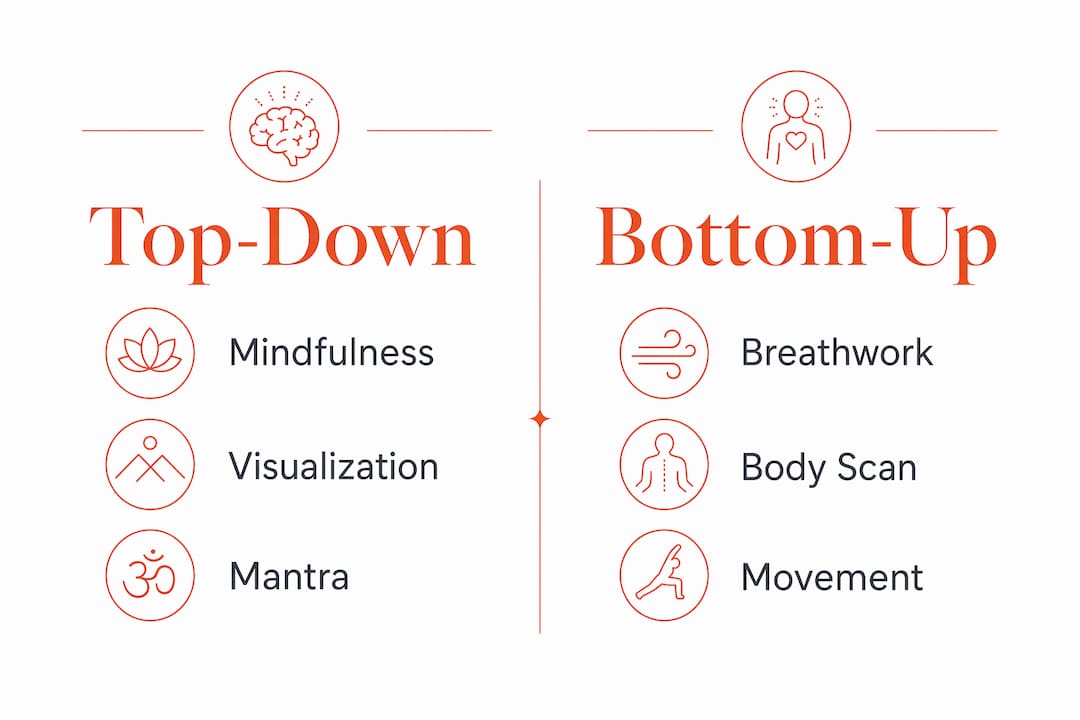
Top-down techniques work through cognition. They include mindfulness observation, visualization, and mantra repetition. These methods engage the thinking mind to redirect attention and reframe experience. They work well when your nervous system is relatively settled and your mood is mild to moderate, such as low-level worry, mild sadness, or general mental fatigue.
Bottom-up techniques work through the body and breath. Structured breathing patterns like box breathing (inhale 4 counts, hold 4, exhale 4, hold 4) or physiological sighing (double inhale through the nose, long exhale through the mouth) directly regulate the autonomic nervous system. These are the right starting point when your emotional state is intense, because they do not require the executive control that stress has already depleted.
Here is a practical breakdown of technique matching by mood:
- Racing thoughts or cognitive anxiety: Active, voice-guided meditation with short prompts. The external voice gives the busy mind something concrete to follow, reducing the chance it wanders back into the worry loop.
- Emotional overwhelm or grief: Visualization practices that create a safe mental space. Imagery of a calm place or a compassionate presence gives the emotional brain a soft landing point.
- Repetitive worry loops: Mantra repetition. A simple repeated phrase, like “I am here” or a Sanskrit mantra, interrupts the loop by occupying the verbal processing channel that worry uses.
- Burnout or low energy: Body scan or progressive muscle relaxation. These practices restore awareness of physical sensation without demanding mental effort.
- Anger or agitation: Breath-focused techniques first, then a transition to RAIN meditation. RAIN stands for Recognize, Allow, Investigate, and Nurture, a four-step process that meets strong emotions with curiosity rather than resistance.
Pro Tip: If you try a technique and feel more tense after two minutes, stop. That is data, not failure. Switch to a simpler breath-focused method and try the original technique again on a calmer day.
The mistake most people make is treating meditation as a single skill. Mindfulness, breathwork, mantra, and visualization are as different from each other as running, swimming, and weightlifting. Each serves a different physiological and psychological purpose. Matching the method to the moment is not optional. It is the whole point.
How to identify your mood before you meditate
Choosing the right practice starts with an honest read of your current state. Most people skip this step entirely, which is why they end up using a calm-focused technique when they are actually wired, or an energizing practice when they are already depleted.
A simple pre-session check takes less than 60 seconds and dramatically improves your results. Use this process:
- Pause and breathe once. Take one slow breath before you do anything else. This brief pause interrupts autopilot and brings you into the present moment.
- Name the emotion. Ask yourself: what am I feeling right now? Use a single word. Anxious, flat, irritable, sad, scattered. Naming an emotion activates the prefrontal cortex and begins to reduce its intensity on its own.
- Rate the intensity. Score it from 1 (barely noticeable) to 10 (overwhelming). This tells you whether you need a bottom-up or top-down technique.
- Identify the physical signal. Where do you feel it in your body? Chest tightness, jaw tension, and shallow breathing all point to high activation. Heaviness in the limbs or a flat, low-energy feeling points to low activation.
- Choose your technique. High activation (score 6 and above) calls for breath-based or body-based methods first. Low activation (score 5 and below) responds better to visualization, gentle body scanning, or guided narrative meditation.
Session length matters too. A high-intensity emotional state calls for a shorter session, around 5 minutes, with a clear structure. Longer open-ended sessions during emotional flooding increase the risk of getting stuck in the feeling rather than moving through it. As your state settles, you can extend the session or shift to a more open awareness practice.
Pro Tip: Keep a simple mood log for one week. Write one word for your pre-session state and one word for your post-session state. Patterns emerge quickly, and you will start to see which techniques consistently work for your specific emotional profile.
What happens when meditation and mood are mismatched?
Mismatched meditation is not just ineffective. It can actively cause harm. Between 10.1% and 27.9% of digital meditation users report at least one adverse experience, including anxiety spikes, emotional flooding, or dissociation. Functional impairment rates range from 3% to 6.7% across controlled trials. Those numbers are not rare edge cases. They represent a real and underreported problem in self-directed practice.
The most common adverse experiences include:
- Increased anxiety: Techniques that demand sustained inward focus can amplify anxious thoughts in people with high baseline anxiety.
- Emotional flooding: Open awareness practices can surface suppressed emotions faster than a person can process them, especially without guidance.
- Depersonalization: Extended sessions of certain concentration practices can produce a detached, unreal feeling, particularly in people prone to dissociation.
- Secondary anxiety: The experience of feeling anxious about feeling anxious during meditation, which creates a feedback loop that is hard to exit without a structured technique.
“Meditation does not eliminate difficult emotions. It changes your relationship to them. When the technique matches the state, that shift feels like relief. When it does not, it can feel like being trapped.”
The predictors of adverse experiences are well-documented. High baseline anxiety, a history of trauma, and using techniques without any personalization or guidance all increase risk. The solution is not to avoid meditation. It is to match techniques to nervous system activation patterns, which prevents agitation and supports consistent practice.
If you experience persistent distress during or after meditation, that is a signal to seek guidance from a qualified teacher or mental health professional. Meditation is a powerful tool. Like any powerful tool, it requires the right application.
Key takeaways
Meditation works best when the technique fits the emotional state you bring to the session, not the other way around.
| Point | Details |
|---|---|
| Mood determines technique | High activation states need breath-based methods; low activation responds to visualization or body scanning. |
| Mismatch causes real harm | Up to 27.9% of digital meditation users report adverse experiences, often from poorly matched practices. |
| Brief sessions work | A 5-minute mood-matched session produces a large, immediate reduction in negative mood (Cohen’s d = 1.00). |
| Check before you sit | A 60-second pre-session mood check dramatically improves technique selection and outcomes. |
| Emotions shift, not disappear | Effective meditation creates distance from rumination; it does not erase the feeling. |
The part most meditation advice gets wrong
Most meditation content treats the practice as a single, universal activity. Sit down, close your eyes, focus on your breath. Repeat daily. That advice is not wrong, exactly. It is just incomplete in a way that causes real problems for real people.
What I have noticed, both in my own practice and in watching others struggle with it, is that the people who quit meditation almost always quit after a session that made them feel worse. They sat down anxious and stood up more anxious. They concluded that meditation does not work for them. The actual problem was never meditation. It was the mismatch.
The research on emotion processing and meditation confirms what practitioners have known intuitively for a long time: the practice has to meet you where you are. A technique that works beautifully on a calm Tuesday morning may be the worst possible choice on a Thursday afternoon after a brutal meeting. Treating those two moments as identical is the core error.
There is also a compassion problem. Most people approach a difficult mood as something to fix or push through. Mood-matched meditation asks a different question: what does this state actually need? Sometimes the answer is stillness. Sometimes it is movement and breath. Sometimes it is a five-minute guided session that speaks directly to what you are carrying that day. The context-specific approach is not a shortcut. It is the more honest and more effective path.
The practitioners who build lasting habits are the ones who learn to read their own states and respond accordingly. That skill, more than any single technique, is what makes meditation sustainable.
— Giorgio
Mosaiic: meditation that reads the room
Meditation works when it fits your moment. Mosaiic is built on exactly that principle.
Mosaiic is a personalized meditation app that generates a new guided session every day based on what you describe. You tell it what is draining you, whether that is burnout, a rough week, or a loss of motivation, and it writes and narrates a 5-minute session specific to that context. Each session builds on the last, so the practice evolves as you do. The positioning is deliberate: energy, not just calm. Mosaiic is designed to leave you fuller, not sleepier. If you want adaptive meditation sessions that actually respond to your emotional state, Mosaiic offers a Free tier to start with no commitment required.
FAQ
Why does meditation sometimes make anxiety worse?
Meditation can increase anxiety when the technique demands sustained inward focus that the stressed brain cannot sustain. High baseline anxiety is a documented predictor of adverse experiences in digital meditation programs.
What meditation technique is best for emotional overwhelm?
RAIN meditation, which stands for Recognize, Allow, Investigate, and Nurture, is designed specifically for big emotions. It meets feelings with curiosity rather than resistance, reducing the chance of emotional flooding.
How long should a meditation session be when I am in a bad mood?
A structured 5-minute session is more effective than a long open-ended one during high-intensity emotional states. Shorter sessions with clear guidance reduce the risk of getting stuck in difficult feelings.
Can meditation based on emotional state replace therapy?
Mood-matched meditation supports emotional regulation and resilience but does not replace professional mental health care. If meditation consistently produces distress, a qualified therapist or teacher should be consulted.
Does matching meditation with emotions really improve results?
Yes. A 14-day study found that self-directed brief meditation produced a large immediate reduction in negative mood (Cohen’s d = 1.00) across 28 sessions, regardless of baseline anxiety levels.