Why Meditation Should Evolve Daily for Real Growth

Meditation should evolve daily because a static practice plateaus your brain’s capacity for change, while adaptive sessions sustain neuroplasticity and compound your mental and physical gains over time. This is not a preference. It is what the neuroscience and learning science now confirm. A 2026 UC San Diego study found that brain and blood biology shift measurably within just seven days of intensive meditation. That speed of change means your practice needs to keep pace with your growth. Mosaiic was built on exactly this principle: each session should respond to where you are today, not where you were last week.
Why meditation should evolve daily, according to neuroscience
The brain does not respond to repetition the way most people assume. Doing the same ten-minute breath-focus session every morning feels disciplined, but the brain adapts to familiar stimuli quickly and stops generating the same depth of response. This is the same mechanism behind physical training plateaus, and it applies directly to mental practice.
A 2026 study published via ScienceDaily showed that seven days of meditation produced measurable changes in brain connectivity and plasma markers linked to neuron growth and new neural connections. That is a striking finding. It means the brain responds to meditation with the same urgency it applies to physical stress, but only when the practice is novel enough to demand adaptation.

The same research found that meditation-induced brain shifts correlated with mystical-quality experiences and immune system changes, effects typically associated with more extreme interventions. The implication is clear: meditation is a physiological event, not just a mood adjustment. When your sessions evolve in content, length, or focus, you keep triggering that physiological response rather than letting it flatten out.
| Biological Effect | What It Means for Your Practice |
|---|---|
| Reduced inner brain chatter | Quieter default-mode network, better focus between sessions |
| Plasma markers for neuron growth | New neural connections forming, supporting memory and learning |
| Immune system shifts | Systemic body-wide response, not just a mental state change |
| Brain connectivity changes | Improved coordination between attention and emotional regulation regions |
Pro Tip: Track how quickly your attention returns after a distraction during your session. Faster recovery across consecutive days is a more reliable sign of neuroplastic progress than how calm you feel afterward.
How learning science explains the case for evolving your practice
Lev Vygotsky’s Zone of Proximal Development, a concept from educational psychology, describes the sweet spot where a challenge is just beyond your current ability but still reachable with effort. Applied to meditation, this means a session that is too easy produces boredom and habituation, while one that is too hard produces frustration and dropout. The optimal challenge zone is the only place where sustained growth happens.
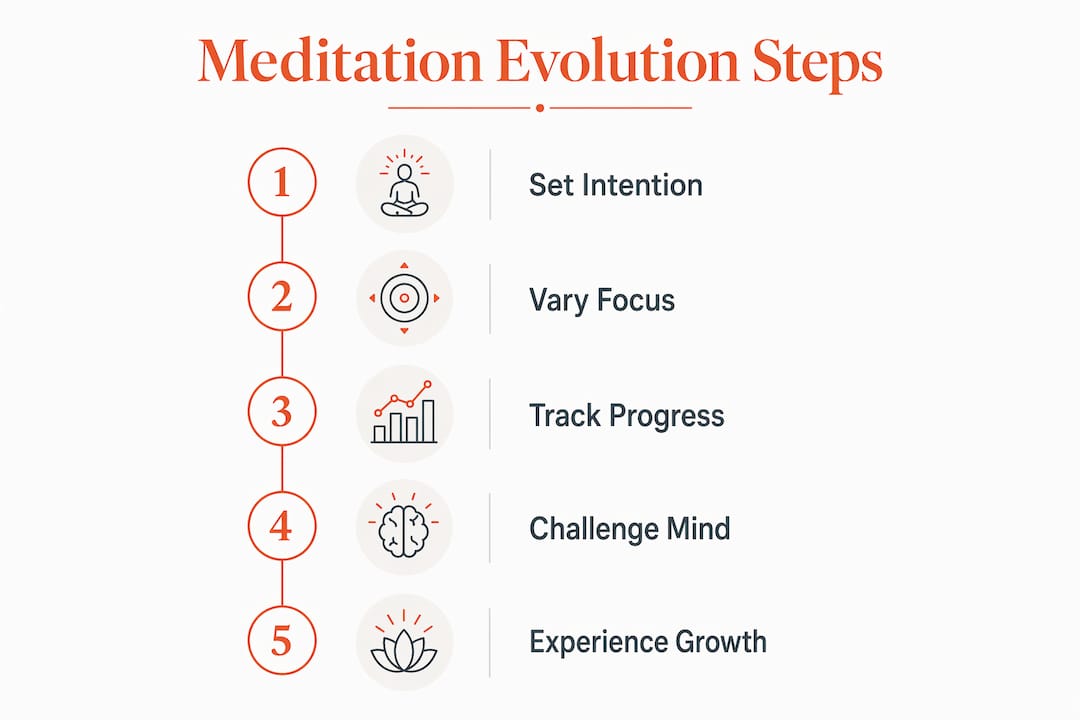
Static meditation practice risks what researchers call a neuroplastic plateau. You stop growing not because you are doing something wrong, but because you are doing the same thing too consistently. Daily adjustment to session type, duration, and focus keeps you inside that productive zone. This is why experienced meditators often report that their hundredth session feels more demanding than their tenth. They have learned to raise the bar.
Here is what daily evolution in meditation practice actually looks like in behavioral terms:
- Shifting from breath focus to body scan when attention feels sharp, to deepen interoceptive awareness
- Extending session length by two to three minutes when you notice attention stabilizing faster than usual
- Introducing open-monitoring practice after weeks of focused attention to challenge meta-awareness
- Reducing session length on high-stress days to stay within attentional capacity rather than forcing through fatigue
- Alternating between guided and silent sessions to prevent over-reliance on external cues
Pro Tip: Use the first five minutes of every session as an entry ramp. Notice how quickly your attention settles. If it settles fast, increase the session’s complexity. If it struggles, simplify and shorten. This single adjustment prevents both boredom and burnout.
What psychological research says about daily meditation benefits
The psychological case for evolving daily meditation is grounded in outcome data, not theory. An 8-week Buddhist mindfulness training program produced statistically significant improvements across awareness (effect size d=1.05), happiness (d=0.78), anxiety reduction (d=0.78), and depression reduction (d=0.64). These are large effect sizes by clinical standards. They signal that daily mindfulness practice produces changes comparable to structured therapeutic interventions.
What makes these numbers meaningful is the mechanism behind them. Daily structure compounds benefits. Each session builds on the neurological state left by the previous one, which is why skipping days disrupts the accumulation effect. The same study found improvements in backward memory and reaction time variability, two markers of executive function that have nothing to do with relaxation. This is meditation improving the brain’s operating system, not just its stress response.
The psychological benefits of consistent, evolving practice extend well beyond calming effects:
- Improved executive function: Better working memory, faster cognitive switching, and reduced impulsivity
- Emotional regulation: Reduced reactivity to negative stimuli, with faster return to baseline after stress
- Reduced anxiety and depression: Clinically meaningful reductions sustained over weeks, not just during sessions
- Increased awareness: Sharper moment-to-moment attention that transfers to work, relationships, and decision-making
- Sustained happiness: Not euphoria, but a measurable increase in baseline positive affect over time
The Cleveland Clinic confirms that regular meditation improves stress, mood, memory, emotional regulation, pain, and sleep. The word “regular” is doing heavy lifting in that sentence. Regularity without evolution produces diminishing returns. Regularity with daily adaptation produces compounding ones.
Practical ways to evolve your meditation sessions every day
Evolving your practice does not mean reinventing it from scratch each morning. It means making deliberate, small adjustments that keep your brain in the growth zone. The most effective approach treats each session as a response to your current state, not a fixed ritual.
| Meditation Type | How to Adapt It Daily |
|---|---|
| Focused attention (breath) | Vary anchor point: breath, sound, or single object; extend duration as focus sharpens |
| Body scan | Increase granularity on sharp days; reduce to broad body zones on fatigued days |
| Loving-kindness (Metta) | Expand circle of recipients as emotional capacity grows; contract on difficult days |
| Open monitoring | Introduce only after focused attention is stable; vary the sensory field you observe |
| Guided visualization | Change narrative context to match current life stressor or energy need |
The entry ramp principle from learning science applies directly here. Treat the first five to ten minutes of any session as a transition zone where you assess your attentional state before committing to a difficulty level. Practitioners who skip this step and jump straight into demanding practice report higher dropout rates and lower perceived benefit.
Progress measurement matters as much as practice design. Most people track meditation by how relaxed they feel afterward. That metric misses the point. Attentional recovery speed, meaning how fast your focus returns after a distraction, reflects actual neuroplastic change. Measure that instead. Keep a simple log: note how many times your attention wandered and how quickly it returned. Improvement in that metric across two weeks signals genuine brain adaptation.
Pro Tip: Set a single intention before each session that reflects your current energy state. “Today I need clarity” produces a different session than “Today I need grounding.” That one-sentence intention is enough to shift the session’s direction without requiring a complete redesign.
Key takeaways
Meditation produces its deepest benefits when it evolves daily to match your current neurological state, challenge level, and energy needs.
| Point | Details |
|---|---|
| Static practice plateaus | Repeating the same session type stops triggering neuroplastic adaptation within days. |
| Seven days produces measurable change | Brain connectivity and immune markers shift within one week of consistent, varied practice. |
| Psychological gains are large and specific | Eight weeks of daily mindfulness produced effect sizes above d=0.64 across anxiety, depression, and awareness. |
| Track attentional recovery, not mood | How fast focus returns after distraction is a more accurate measure of neuroplastic progress. |
| Small daily adjustments sustain growth | Varying session type, length, or focus by even small degrees keeps practice inside the optimal challenge zone. |
Why I stopped treating meditation as a fixed ritual
I spent two years doing the same 12-minute breath-focus session every morning. It felt productive. My stress was lower, my mornings were calmer, and I had the satisfying sense of a completed habit. Then I hit a wall. The sessions felt mechanical. I was going through the motions without any sense of deepening. What I did not realize at the time was that my brain had simply adapted to the routine and stopped growing from it.
The shift happened when I started treating each session as a response to that day’s specific energy state rather than a fixed prescription. On days when I felt scattered, I shortened the session and tightened the focus. On days when I felt sharp, I extended it and introduced open-monitoring practice. The difference was immediate and surprising. Sessions felt alive again. More importantly, I started noticing changes in how I handled difficult moments during the day, not just during the session itself.
The conventional wisdom around meditation tends to emphasize consistency above all else. That is correct but incomplete. Consistency without adaptation is just repetition. The practitioners I have seen make the most sustained progress are the ones who treat their practice as a living system, one that responds to their current state rather than ignoring it. Energy, clarity, and emotional resilience are the real outputs of a well-evolved practice. Calm is a byproduct, not the goal.
— Giorgio
How Mosaiic helps your practice evolve every single day
If designing a different session every morning sounds like more work than you want to take on, that is exactly the problem Mosaiic solves.

Mosaiic is a personalized meditation app that generates a new guided session each day based on what is actually draining your energy. You describe your situation, whether that is burnout, low motivation, or a rough stretch at work, and Mosaiic writes and narrates a five-minute session built specifically for that context. Each session builds on the last, so your daily meditation practice evolves automatically as you progress. The positioning is deliberate: Mosaiic is designed to leave you fuller and more energized, not sleepier. Three tiers are available, Free, Starter, and Daily (Pro), so you can start without commitment and scale as your practice deepens.
FAQ
Why does meditation need to change every day?
The brain adapts quickly to repeated stimuli, which reduces the neuroplastic response over time. Varying session type, length, or focus keeps practice inside the optimal challenge zone where growth continues.
How fast can meditation change the brain?
Brain and immune system changes appear within seven days of consistent meditation practice, according to a 2026 UC San Diego study. Functional shifts can occur even faster, within individual sessions.
What is the best way to measure meditation progress?
Track how quickly your attention recovers after a distraction during your session. Faster recovery across consecutive days reflects neuroplastic gains more accurately than subjective mood ratings.
Can daily meditation reduce anxiety and depression?
An 8-week Buddhist mindfulness program produced significant reductions in anxiety (effect size d=0.78) and depression (d=0.64), with results sustained beyond the training period.
How do I evolve my meditation without overcomplicating it?
Use the first five minutes of each session to assess your attentional state, then adjust session length or type accordingly. One small adjustment per day is enough to prevent habituation and sustain growth.
Recommended
Article was at least partially generated or improved with ai.