How to Shift Meditation Intention to Energy

To shift meditation intention to energy means purposefully redirecting your meditative focus away from relaxation and toward activating your mental and physical vitality. Most people use meditation to wind down. That works, but it leaves a different need unmet: what do you do when you’re exhausted and still need to function? The answer is a two-stage practice combining focused attention with targeted breathwork. Research from 2026 confirms this combination produces measurable physiological changes in minutes. Tools like loving-kindness meditation, Wim Hof Method (WHM) breathwork, and platforms like Mosaiic make this practice accessible without any prior experience.
How does shifting meditation intention to energy actually work?
The mechanism is physiological, not motivational. Meditation and breathwork pull your nervous system in opposite directions, and that contrast is exactly what makes the combination powerful.
A 2026 Frontiers in Psychology feasibility study found that loving-kindness meditation increased nasal temperature (p=0.003), a sign of reduced arousal and deeper calm. Breathwork did the opposite: it raised heart rate (p=0.002) and decreased nasal temperature (p<0.001), signaling a clear shift toward activation. These are not subtle changes. They show up in your body within a single session.

The same study found that meditation promotes a sense of unity and reduced self-focus, while breathwork increases arousal and self-awareness. That contrast matters for energy. Calm attention clears mental noise. Breathwork then fires up the system that calm attention just quieted and prepared. Think of it as setting a clean stage before turning on the lights.
What this means practically: you cannot simply decide to feel energized during meditation. Cognitive intention alone does not raise arousal. The Scientific Reports 2025/2026 trial found that breath-driven physiological signals are required for energy increases. Affirmations and visualization without breath engagement consistently fall short.
Pro Tip: If you feel mentally foggy after a meditation session, that is the calm attention phase working correctly. Do not stop there. Move directly into breathwork to complete the energy transfer.
The mood shift is also fast. SKT1 meditation, a self-directed technique studied over 14 days, produced immediate large mood improvements after every session, with negative mood decreasing at a Cohen’s d of 1.00. That effect size is large by any clinical standard. It means the shift is reliable, not occasional.
What do you need before you start?
Preparation matters more than most guides admit. You do not need a special space or an hour of free time. You need the right mindset and a realistic session structure.
The most important prerequisite is stress reduction. A 2026 Motivation and Emotion randomized trial found that stress reduction predicted goal progress, while autonomous motivation did not. That finding flips the common assumption. You do not need to want to feel energized badly enough. You need to lower your stress load first, and the energy and motivation follow downstream.
Here is what a minimal setup looks like:
- Session length: 6–12 minutes daily. The Motivation and Emotion 2026 study confirmed that short daily sessions over four weeks significantly reduce perceived stress and improve goal progress compared to a waitlist control.
- Environment: A quiet spot where you will not be interrupted. Seated upright works better than lying down for the breathwork phase.
- Audio support: Guided breathwork audio or a meditation app that sequences calm attention before activation. Mosaiic builds this sequence into every session automatically.
- Timer: Any basic meditation timer app works for unguided practice.
- Consistency over duration: Frequency beats length. Daily 8-minute sessions outperform weekly 45-minute sessions for energy alignment.
The comparison below shows how two common approaches differ in their energy outcomes:
| Approach | Primary Effect | Best For |
|---|---|---|
| Relaxation meditation only | Lowers arousal, reduces stress | Sleep, recovery, anxiety |
| Breathwork only | Raises arousal, increases heart rate | Acute energy boost, pre-task activation |
| Calm attention + breathwork | Lowers then raises arousal in sequence | Sustained energy, motivation, mental clarity |
The two-stage sequence wins for energy because it uses both effects in the right order. Relaxation first clears the mental clutter that blocks activation. Breathwork then has a cleaner physiological surface to work on.
You can explore energy-focused meditation examples to see how different techniques fit into this framework before you commit to a routine.
Step-by-step: how to practice the energy intention shift
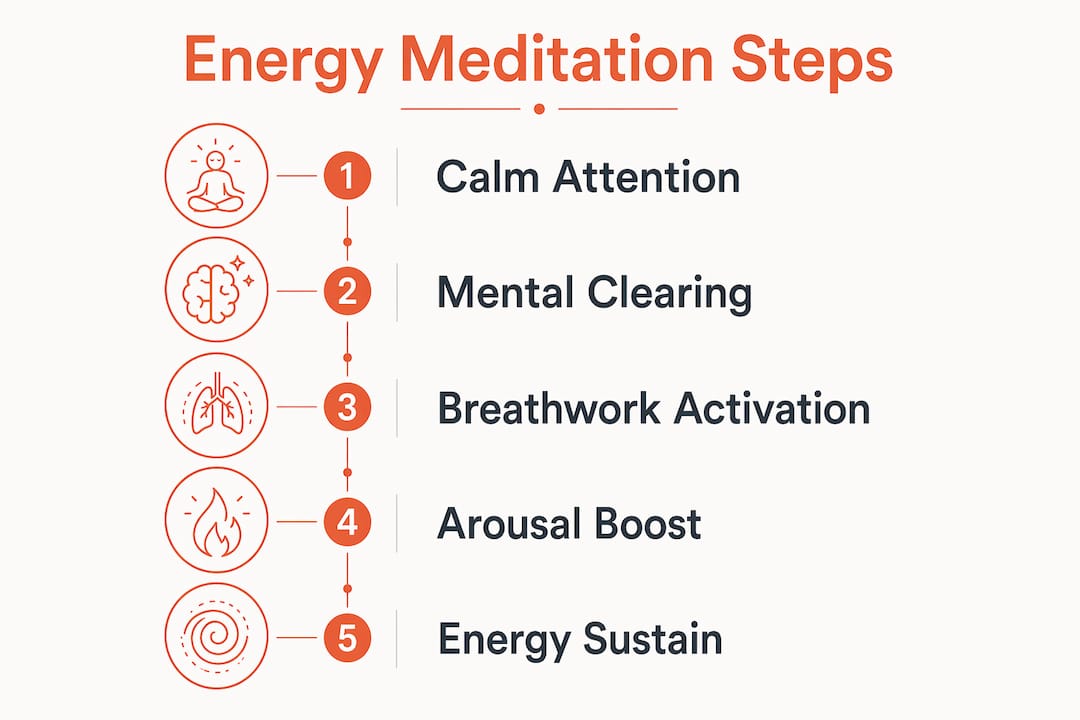
This is the core practice. Follow the sequence exactly, especially when you are exhausted. The order is not arbitrary.
-
Settle your attention (2–3 minutes). Sit upright and close your eyes. Focus on a simple loving-kindness phrase directed at yourself: “May I be well. May I be clear.” Repeat slowly. The goal is not bliss. The goal is to stop the mental chatter that drains energy before you even begin. Your heart rate will naturally slow. Let it.
-
Anchor your breath (1–2 minutes). Shift attention to nasal breathing only. Breathe in for four counts, out for four counts. This phase bridges calm attention and active breathwork. It tells your nervous system a change is coming without shocking it.
-
Activate with breathwork (3–5 minutes). Move into your chosen breathwork protocol. WHM (Wim Hof Method) uses rapid deep inhales followed by passive exhales in rounds of 30 breaths. SKT1 uses rhythmic breath cycles with brief retention. Both produce the physiological activation documented in the Scientific Reports trial, including greater momentary energy and mental clarity compared to meditation alone. Pick one and stay consistent.
-
Notice the shift (30–60 seconds). After breathwork, pause. Notice your heart rate, the warmth in your hands, the sharpness of your focus. This is not a ritual. It is a calibration check. Recognizing the shift reinforces the intention and trains your brain to associate the practice with activation.
-
Set a single clear intention (1 minute). Before opening your eyes, name one thing you will do in the next hour. Not a goal list. One thing. The combination of reduced mental noise and elevated arousal makes this intention stick in a way that pre-meditation goal-setting rarely does.
Pro Tip: The most common mistake is skipping step one and going straight to breathwork. Without the calm attention phase, breathwork often produces anxiety rather than energy. The two-stage sequence is the mechanism, not a preference.
For a structured morning version of this practice, the morning energy activation ritual on Mosaiic walks through the full sequence with guided audio.
Why is your energy shift not working?
If you have tried intention setting meditation and still feel flat afterward, the problem is almost always one of three things.
You are relying on cognition instead of breath. This is the most common failure. Repeating “I am energized” without engaging breathwork does not raise arousal. The Scientific Reports 2025/2026 trial is direct on this point: breath-driven physiological signals are required. Cognitive intention alone is insufficient. If your sessions feel like affirmation exercises, add active breathwork immediately.
You are forcing it. Overexertion during breathwork produces dizziness, not energy. WHM and SKT1 both require relaxed effort. You breathe fully but without strain. If you feel lightheaded, slow down. The dose-dependent benefits documented in the Scientific Reports trial build over days, not in a single aggressive session.
You are not practicing often enough. The PLOS ONE 2026 study tracked an average of 26.3 sessions over 14 days and found stable, reliable effect sizes throughout. That is roughly twice daily. You do not need that frequency to see results, but once every few days will not build the physiological pattern your nervous system needs to respond predictably.
Other common barriers worth addressing:
- Wrong session timing: Breathwork right before sleep disrupts rest. Morning or midday works best for energy goals.
- No tracking: Without any record, you cannot tell if the practice is working or if you need to adjust the breathwork protocol.
- Skipping the calm phase: As noted above, this turns breathwork into a stress response rather than an energy response.
Adaptive meditation techniques can help you adjust your approach based on what is actually draining you each day, which is especially useful during extended periods of exhaustion.
Key takeaways
Shifting meditation intention to energy requires a two-stage sequence: calm attention first to clear mental noise, then breathwork to raise physiological arousal and produce real, measurable energy.
| Point | Details |
|---|---|
| Two-stage sequence is required | Calm meditation lowers arousal first; breathwork then raises it for net energy gain. |
| Breath drives the shift | Cognitive intention alone cannot raise arousal; breathwork protocols are the active mechanism. |
| Short sessions work | Daily 6–12 minute sessions reliably reduce stress and improve goal progress within four weeks. |
| Stress reduction comes first | Lowering stress predicts motivation gains more reliably than willpower or intention alone. |
| Frequency beats duration | Consistent daily practice produces stable mood and energy shifts; occasional long sessions do not. |
What i have learned from practicing this daily
I spent years treating meditation as a recovery tool. Calm down, slow the breath, reduce the noise. That works. But it left me with a problem: I would finish a session feeling peaceful and completely unmotivated to do anything with that peace.
The shift happened when I stopped treating breathwork as a separate practice and started treating it as the second half of every session. The Frontiers in Psychology research confirmed what I had already noticed: meditation and breathwork are not competing methods. They are sequential tools. One clears the system. The other activates it.
What surprised me most was how fast the mood shift occurs. The PLOS ONE data on SKT1 showed large effect sizes after a single session, and that matches my experience. You do not need to build up to it over weeks. The first time you run the full two-stage sequence correctly, you feel the difference within minutes.
The practical lesson I keep coming back to: stop trying to think your way into energy. The breath is the lever. Intention sets the direction, but breath moves the body. When you are genuinely exhausted, that distinction is the difference between a session that leaves you sharper and one that just makes you sleepy.
If you are in a rough stretch and standard relaxation meditation is making things worse, not better, the two-stage approach is worth trying today. Keep it under 10 minutes. Do not skip the calm phase. Let the breathwork do the physiological work.
— Giorgio
Mosaiic builds this sequence into every session
Mosaiic is a personalized meditation app built around the principle that meditation should leave you fuller, not sleepier. You describe what is draining you, and Mosaiic generates a guided 5-minute session written and narrated specifically for that context. Each session builds on the last, so the practice adapts as you progress.
The app sequences calm attention and breathwork automatically, so you do not have to manage the two-stage structure yourself. Free sample sessions are available, with Starter and Daily (Pro) tiers for full access. If you want a practice designed for energy and motivation rather than generic relaxation, start with Mosaiic and let the app do the sequencing for you.
FAQ
What does it mean to shift meditation intention to energy?
It means redirecting your meditative focus from relaxation toward physiological and mental activation. The practical method combines calm attention with breathwork to first lower and then raise arousal in sequence.
How long does a session need to be to boost energy?
Research from the Motivation and Emotion 2026 trial shows that 6–12 minute daily sessions over four weeks significantly reduce stress and improve goal progress. Shorter is fine; less frequent is not.
Why does breathwork raise energy better than meditation alone?
Breathwork directly increases heart rate and decreases nasal temperature, signaling nervous system activation. Meditation does the opposite. The Frontiers in Psychology 2026 study documented both effects in the same session, confirming they work through different physiological pathways.
Can i use affirmations instead of breathwork to generate energy?
No. The Scientific Reports trial found that cognitive intention alone does not raise arousal. Breathwork protocols like WHM or SKT1 are required to produce the physiological activation that translates into felt energy.
How quickly will i notice a difference?
The PLOS ONE 2026 study found large immediate mood improvements after a single SKT1 session, with consistent effects across 26+ sessions. Most people notice a shift within the first two or three correctly sequenced sessions.