How Meditation Scripts Are Generated: A Practical Guide

Meditation scripts are structured verbal guides that combine spoken language and deliberate silence to move a person through a focused mindfulness experience. Understanding how meditation scripts are generated matters because the process is more layered than most people expect. A good script is not just words on a page. It requires a specific architecture, a calibrated pace, and carefully placed silence. Today, tools like ChatGPT and Claude accelerate the drafting process, but scripted meditation still depends on human judgment to land with emotional weight.
What are the key structural elements of a meditation script?
Every effective meditation script follows a predictable phase structure. That predictability is not a creative limitation. It is a feature. The brain relaxes faster when it knows what is coming next.
The five core phases are:
- Induction — Settles the listener into the body through breath focus or physical grounding cues.
- Body scan — Moves attention systematically through the body, typically feet to head.
- Deepening — Extends relaxation or introduces visualization to anchor the meditative state.
- Rest — The quietest phase, where the listener simply sits in awareness with minimal narration.
- Return — Gently brings the listener back. A jarring return like a blunt “open your eyes” can undo the calm built across the entire session.
Each phase has a distinct job. The induction reduces mental noise. The body scan uses what researchers call the spotlight method, moving attention in a fixed, bottom-up sequence that calms the nervous system by engaging the brain’s proprioceptive map in a predictable order. The deepening phase is where imagery or breath counting takes hold. The rest phase is where silence does the real work.
Pro Tip: Write the return phase last and spend as much time on it as the induction. A rushed return is the most common mistake in beginner scripts.

Pacing is built into the structure from the start. A 5-minute script targets roughly 500 words, based on a delivery rate of about 100 words per minute. That word count leaves room for the pauses that make the script breathe.
How does AI generate meditation scripts?
AI tools like ChatGPT and Claude generate meditation scripts by processing a detailed prompt and producing natural language output structured around your instructions. The quality of the output depends almost entirely on the quality of the prompt.
A well-built prompt for AI-personalized scripts typically specifies:
- Mood or emotional state (e.g., anxious, depleted, unfocused)
- Meditation type (body scan, breath focus, visualization, NSDR)
- Tone and style (warm and slow, neutral and clinical, nature-based imagery)
- Target duration (5 minutes, 10 minutes, 20 minutes)
- Audience (beginner, experienced practitioner, specific life context)
AI handles the drafting phase well. It generates coherent language quickly, maintains a consistent tone across a full script, and can produce multiple variations in minutes. That speed is genuinely useful when you are building a library of scripts or testing different styles.
The limitations are real, though. AI does not naturally build in silence. It fills space with words because that is what language models do. The output also tends to lack the subtle rhythm of a human voice, the slight elongation before a key phrase, the breath that signals a pause is coming. AI is roughly 20% of the process. Human delivery and editing make the difference.
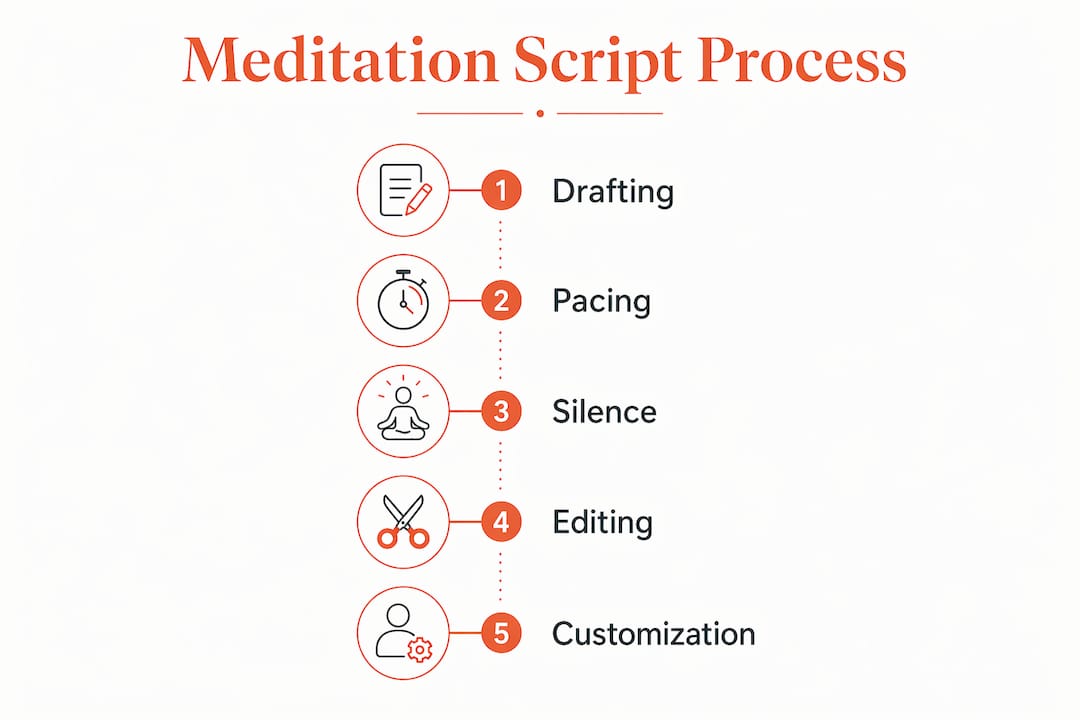
Pro Tip: After generating a draft with AI, read it aloud before editing. Your voice will find the awkward phrases and missing pauses faster than your eyes will.
Tools like Elora are built specifically to bridge this gap. They allow creators to insert breath gap markers and use voice cloning to produce audio that sounds human rather than robotic. The natural cadence of a real voice, including inhale and exhale cues, is what separates a meditation that works from one that feels mechanical.
Why does silence matter more than the words?
Silence is the most underused element in meditation script writing. Researchers at NSDR.co state directly that planned silence is the most critical ingredient in any script, because silence is where attentional shifts actually happen. Words set the stage. Silence is where the mind moves.
Most first-time script writers fill every second with narration. The result is a session that feels like a lecture rather than a meditation. The listener never gets space to drop into the experience because the voice keeps pulling them back to the surface.
Practical methods for building silence into a script:
- Use ellipsis markers in your written draft to signal pause points. Three dots (…) represent a short breath pause. Six dots (… ) represent a longer rest.
- Mark breath cues explicitly with labels like [inhale], [exhale], or [hold] so any reader or text-to-speech engine knows where to pause.
- Write silence into the phase structure. The rest phase should have the fewest words of any section. A 5-minute script might have only 2–3 sentences in the rest phase.
- Test with a timer. Read your script aloud and time each phase. If the rest phase feels uncomfortably long, that discomfort is the point.
“Silence is not empty; it’s the active space where mindfulness deepens.” — NSDR.co
Deliberate breath gap markers in a written script also serve a technical function. When a script is converted to audio using a text-to-speech engine, those markers instruct the system on exactly when to pause and for how long. Without them, the audio sounds like a continuous stream of words with no room to breathe.
How can you customize meditation scripts for personal use?
Customizing a meditation script starts with one clear decision: what do you want to feel at the end? That single question shapes every other choice, from the imagery you use to the length of the pauses.
The most effective approach is to start with a meditation script template or an AI draft and treat it as raw material rather than a finished product. Here is how to make it yours:
- Choose a specific emotional target. “Calm” is too broad. “Less reactive after a difficult conversation” is specific enough to write toward.
- Replace generic imagery with personal imagery. If a forest setting does not resonate with you, swap it for a place that does. The brain responds to familiar sensory detail more readily than abstract scenes.
- Adjust the pacing to your own breath. Read the script aloud and mark every place where you naturally want to pause. Those marks become your silence cues.
- Match the length to your actual schedule. A 5-minute script you use daily beats a 20-minute script you skip. The user input you bring to a session, including your context and emotional state, shapes how the script lands.
- Record yourself. Even a rough phone recording reveals pacing problems that silent reading misses entirely.
For people who want to go further, voice cloning tools allow you to narrate a script once and generate audio in your own voice at scale. That personal voice quality creates a level of familiarity that no generic narrator can replicate. Context-specific scripts built around a real situation, like a difficult week at work or a period of low motivation, consistently outperform generic relaxation scripts in terms of engagement and follow-through.
Pro Tip: Keep a short log of how you feel before and after each session. After two weeks, patterns emerge that tell you which script elements are actually working for you.
Key takeaways
Effective meditation scripts combine a clear phase structure, calibrated pacing, and deliberate silence. AI accelerates drafting but human refinement determines whether a script actually works.
| Point | Details |
|---|---|
| Phase structure matters | Scripts follow five phases: induction, body scan, deepening, rest, and return. |
| Pacing is a math problem | A 5-minute script targets roughly 500 words at 100 words per minute. |
| Silence does the real work | Planned pauses are where attentional shifts happen, not the words between them. |
| AI drafts need human editing | AI generates language quickly but lacks natural cadence and breath rhythm. |
| Customization drives results | Scripts built around a specific emotional target outperform generic relaxation guides. |
What I’ve learned from watching people use AI to write meditation scripts
Most people who start writing their own meditation scripts make the same mistake: they treat the AI output as the finished product. They generate a script, read it once, and record it. Then they wonder why the session feels flat.
The text is only the skeleton. What makes a meditation script work is the space between the sentences, the slight hesitation before a key phrase, and the warmth in the delivery. AI cannot manufacture those things. It can give you a solid first draft in under two minutes, and that is genuinely useful. But the moment you stop editing and start trusting the raw output, you lose the human element that makes meditation land.
The other pattern I see is over-reliance on imagery. Writers pack scripts with elaborate visualizations because they feel creative and immersive on the page. In practice, a listener who is already stressed cannot track a complex scene. Simple, grounded language works better. “Feel the weight of your body” beats “imagine yourself floating above a sunlit valley” for most people in most states.
The best scripts I have encountered are almost boring to read. Short sentences. Long pauses. A clear emotional destination. The craft is in what you leave out.
— Giorgio
Try Mosaiic for daily personalized meditation sessions
Mosaiic builds the kind of personalized meditation experience that most people spend hours trying to create manually. You describe what is draining you, and Mosaiic writes and narrates a 5-minute session built around that specific context. Each session builds on the last, so the script evolves as you do.

Mosaiic is designed around energy, not just calm. The goal is to leave you fuller after a session, not sleepier. If you have been experimenting with creating your own scripts and want a tool that handles the generation, pacing, and narration for you, Mosaiic is worth exploring. Free sample sessions are available with no commitment required.
FAQ
What is a meditation script?
A meditation script is a written guide that leads a listener through a structured mindfulness session using spoken language and planned silence. It typically follows phases including induction, body scan, deepening, rest, and return.
How long should a meditation script be?
A 5-minute meditation script should contain roughly 500 words, based on a delivery pace of 100 words per minute. Longer sessions scale proportionally, with more silence built into the rest phase.
Can AI write a complete meditation script?
AI tools like ChatGPT and Claude can generate a full draft quickly, but the output requires human editing for pacing, silence markers, and emotional tone. AI covers about 20% of the process. Human refinement covers the rest.
What makes a meditation script effective?
Planned silence is the most critical factor. Attentional shifts happen in the pauses, not during narration. A script that fills every second with words prevents the listener from dropping into a genuine meditative state.
How do I customize a meditation script for personal use?
Start with a template or AI draft, then replace generic imagery with personal references, adjust pacing to your own breath, and record yourself reading it aloud. Scripts built around a specific emotional target, like recovering from burnout or resetting after conflict, work better than generic relaxation guides.