Meditation for Energy Restoration: Reclaim Your Vitality

Meditation for energy restoration is a structured practice that replenishes your cognitive and emotional reserves by grounding your nervous system, clearing accumulated stress, and sealing your energy field against further depletion. Unlike a nap or a scroll through your phone, this approach actively disengages the fight-or-flight response and returns your body to a state where real recovery can happen. The core techniques covered here, including grounding, clearing, and sealing, are backed by research on attentional recovery and autonomic nervous system regulation. If you are running on empty, this is where you start.
What does energy restoration mean in meditation?
Energy restoration in meditation is defined as the active process of optimizing your internal energy by stopping rumination, activating the parasympathetic nervous system, and clearing the residue of accumulated stress. It is not the same as passive rest, and that distinction matters more than most people realize.
When you lie on the couch after a hard day, your body may be still, but your mind keeps processing. Passive rest often fails to restore energy under pressure because the nervous system remains partially engaged, running background processes on unresolved stressors. You wake up from a nap still tired. That is not a personal failure. That is biology.
Meditation interrupts that cycle. Meditation shifts the autonomic nervous system from sympathetic activation to parasympathetic recovery, stopping what researchers describe as “invisible leaks” of metabolic energy. Every minute you spend in low-grade anxiety or mental replay burns fuel you cannot see leaving.
“Meditation doesn’t add energy. It optimizes what you already have by dissolving internal tension and energetic residue, returning you to a natural state of vitality.”
The mechanisms behind this are concrete. Neural restoration occurs as the default mode network quiets. Cortisol drops. Emotional clearing removes the cognitive load of unprocessed feelings. Mindfulness meditation restores attentional capacity more effectively than passive rest, with 10–20 minutes returning cognitive performance to pre-depletion levels. That is the difference between a reset and a pause.
What are the core techniques for energy restoration?
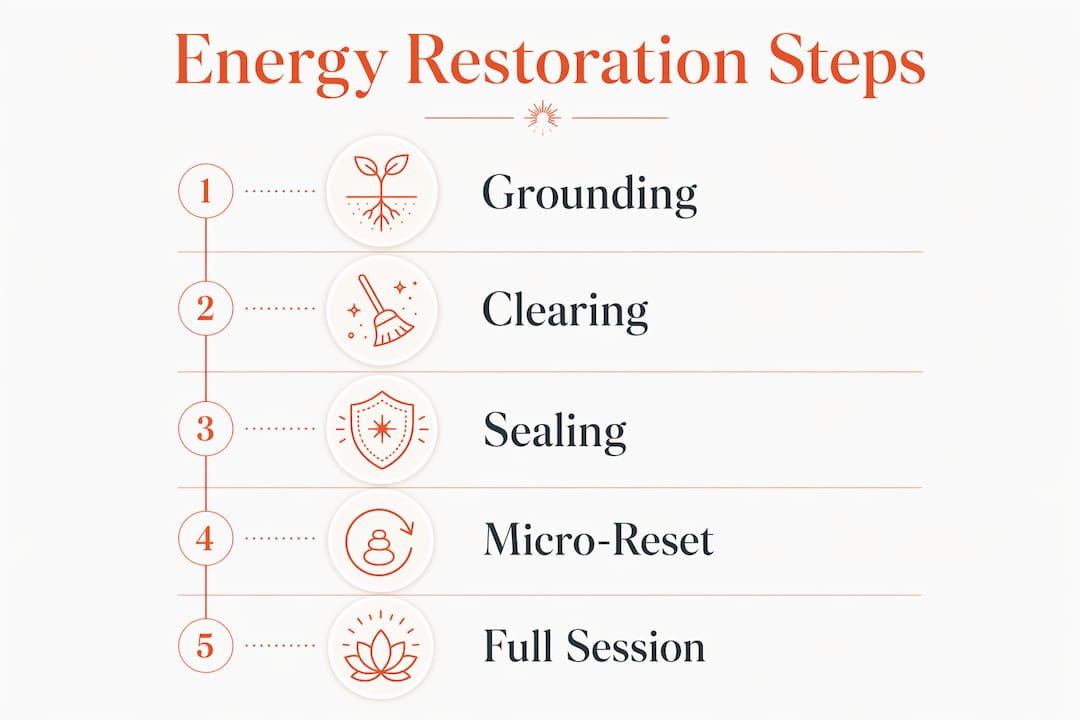
The three non-negotiable steps in energy restoration meditation are grounding, clearing, and sealing. Each one serves a distinct function. Skipping any of them is like rebooting a computer while leaving half the programs running. You get a partial restart at best.

Grounding: anchor before you clear
Grounding is the first step, and it is the one most people skip when they are burned out and impatient. Grounding anchors scattered energy by redirecting anxious, upward-moving mental activity back into the body and, through visualization, into the earth. The classic technique involves imagining a cord or root extending from the base of your spine down through the floor and into the ground. You breathe into it. You let it hold weight.
Without this step, the clearing phase can leave you feeling disconnected or spacey rather than restored. Grounding is especially critical for burned-out individuals because their energy is typically fragmented and upward-displaced, living in the head rather than the body.
Clearing: release what is draining you
Clearing is the active discharge phase. You visualize stagnant energy, accumulated stress, or emotional residue leaving your body. Guided visualization techniques instruct the energy system to relax and release fatigue more effectively than unguided attempts at “letting go.” Imagery like warm light moving through your body, or dark fog dissolving outward, gives your nervous system a concrete target. Effortful willpower does not work here. Imagery does.
Sealing: lock in the restoration
Sealing is the step most beginners never learn about, and it explains why some people feel great during meditation but depleted again within an hour. Effective energy restoration requires sealing after clearing to prevent re-absorption of draining energies. The technique involves visualizing a protective boundary around your body, often described as a bubble of light or a membrane of warmth, that holds your restored state in place.
Pro Tip: If you consistently feel spacey or re-drained after meditating, you are almost certainly skipping the sealing step. Add two minutes at the end of any session to visualize a clear, protective boundary around your entire body before you open your eyes.
| Step | Purpose | Key Action | Outcome |
|---|---|---|---|
| Grounding | Anchor scattered energy | Visualize a cord from spine to earth | Stability, presence, reduced anxiety |
| Clearing | Release accumulated stress | Visualize fatigue or tension leaving the body | Lighter emotional load, mental clarity |
| Sealing | Protect restored state | Visualize a protective boundary around the body | Sustained energy, reduced re-depletion |
How to practice energy restoration meditation step by step
A full energy restoration session takes 10–20 minutes. A micro-reset version takes 5 minutes and fits between meetings. Both follow the same structure. What changes is depth, not sequence.
Preparation
Find a seated position with your feet flat on the floor. This is not optional for grounding. Lying down works for clearing and sealing but makes grounding harder because the physical connection to the floor is weaker. Set a timer so you are not checking the clock. Dim the lights if you can.
The session
- Close your eyes and take three slow breaths. Exhale longer than you inhale. This alone begins the parasympathetic shift.
- Ground yourself. Visualize a cord or root from the base of your spine extending down through the floor, through the building, and into the earth. Breathe into it for 2–3 minutes. Feel your weight settle.
- Scan your body for tension. Notice where you are holding stress. Shoulders, jaw, chest, gut. Do not try to fix it yet. Just locate it.
- Begin clearing. Visualize warm light entering through the top of your head with each inhale. With each exhale, see gray or dark energy leaving through your feet into the ground. Spend 4–6 minutes here.
- Deepen the clearing with a specific image. Picture the exact situation draining you, a difficult conversation, a deadline, a relationship. See it as an object outside your body. Breathe it out. Let the earth absorb it.
- Seal your energy field. Visualize a clear, warm bubble of light surrounding your entire body. Breathe into it. Feel it hold. Spend 2 minutes here.
- Return slowly. Wiggle your fingers and toes. Take one full breath. Open your eyes.
Short, focused 5–10 minute guided meditations that visualize energy refilling outperform longer, general quieting sessions during high fatigue. This means a tight, intentional 5-minute session beats a vague 30-minute one when you are genuinely depleted.
Pro Tip: For a morning energy ritual, pair this practice with the morning energy activation approach, which front-loads the grounding step to set your nervous system baseline for the entire day.
For daily integration, the micro-reset version (steps 1, 2, 4, and 6 only) takes under 5 minutes and works well between tasks. The full session is best done once daily, ideally mid-afternoon when the post-lunch cortisol dip hits hardest.
How does guided meditation accelerate energy recovery?
Guided meditation outperforms silent practice for energy restoration because most burned-out people cannot sustain visualization on their own. When you are depleted, your attention wanders within seconds. A guiding voice holds the thread.
Energy-focused meditation works best with guided visualization because it directs the energy field the way a muscle responds to intentional command. Without direction, the mind defaults to the exact rumination loops that caused the depletion in the first place. A guided session interrupts that default.
The most effective guided formats for energy renewal share specific features. When evaluating any app or audio resource for this purpose, look for:
- Sessions specifically labeled for energy, vitality, or restoration rather than general relaxation
- Explicit grounding instructions at the start, not just breath awareness
- Visualization prompts that name specific imagery (light, warmth, roots, protective boundaries)
- Session lengths of 5–15 minutes, not 30–45 minutes
- Daily progression so each session builds on the previous one rather than repeating the same script
Mosaiic is built around exactly this model. Users describe their specific situation, whether burnout, loss of motivation, or a rough stretch, and the app generates a narrated 5-minute session tailored to that context. Each day’s session evolves based on where the user is, which is the difference between a tool that adapts and one that just plays the same track on repeat. You can explore energy-focused meditation examples to see how targeted visualization differs from standard mindfulness content.
The work-life balance research from 2026 confirms that personalized, context-aware wellness tools produce measurably better recovery outcomes than generic programs. Personalization is not a feature. It is the mechanism.
Key takeaways
Meditation for energy restoration works because it actively stops the nervous system’s energy leaks, not because it adds something new to your system.
| Point | Details |
|---|---|
| Meditation beats passive rest | Mindfulness restores attentional capacity in 10–20 minutes; passive rest often leaves stress processing running in the background. |
| Three steps are non-negotiable | Grounding, clearing, and sealing must all be completed for lasting restoration rather than temporary relief. |
| Sealing prevents re-depletion | Without a closing visualization, sensitive individuals report feeling spacey or drained again within an hour of practice. |
| Short sessions outperform long ones | Focused 5–10 minute energy visualizations outperform longer general sessions during high fatigue. |
| Guided beats silent for burnout | Guided visualization holds attention and directs the energy field more effectively than unguided practice when you are depleted. |
Why most people are meditating for the wrong goal
I have spent years watching people approach meditation as a sedative. They want to feel calm. They want to feel less. That framing is exactly why so many people meditate for a few weeks and then stop, because calm without energy is just a quieter version of exhausted.
The shift that changed everything for me was understanding that meditation is not a dimmer switch. It is a reset button. The goal is not to feel less. It is to stop leaking. Once I started treating grounding as mandatory rather than optional, and once I added the sealing step consistently, the sessions that used to leave me feeling floaty started leaving me feeling solid.
The other thing most articles will not tell you: clearing only works when you give it a specific target. Vague intentions to “release stress” accomplish very little. When you name the meeting, the person, the deadline, and then breathe it out as a concrete image, something actually shifts. That specificity is what separates a meditation that restores energy from one that just passes time.
The adaptive meditation approach gets this right. When your session is written around your actual situation rather than a generic script, the clearing step has real material to work with. That is not a spiritual claim. That is just how attention and intention operate in the nervous system.
If you are burned out and skeptical, start with five minutes, feet on the floor, one specific thing to release, and a closing breath to seal it. Do that for seven days before you decide it does not work.
— Giorgio
Restore your energy with Mosaiic
Feeling burned out is not a willpower problem. It is a system problem, and the system needs a specific kind of input to recover.

Mosaiic generates a personalized 5-minute guided meditation every day based on exactly what is draining you. You describe your situation, and the app writes and narrates a session built around it. Each day builds on the last. The positioning is deliberate: energy, not just calm. Mosaiic is designed to leave you fuller, not sleepier. Free sample sessions are available with no commitment. If you are ready to stop running on empty, start your first session at Mosaiic today.
FAQ
What does energy restoration mean in meditation?
Energy restoration in meditation means actively replenishing your cognitive and emotional reserves by stopping rumination, activating the parasympathetic nervous system, and clearing accumulated stress through structured visualization techniques.
How long does a meditation session need to be to restore energy?
Research shows that 10–20 minutes restores attentional capacity to pre-depletion levels, but focused 5–10 minute energy visualization sessions outperform longer general sessions during high fatigue.
Why do i feel spacey after meditating instead of restored?
Feeling spacey after meditation almost always means you skipped the sealing step. Without a closing visualization that establishes a protective boundary, cleared energy leaves you open to re-absorbing the same draining inputs.
Is guided or silent meditation better for energy restoration?
Guided meditation is more effective for burned-out individuals because it sustains visualization and prevents the mind from defaulting to the rumination loops that caused depletion in the first place.
Can meditation replace sleep for energy recovery?
Meditation does not replace sleep. It addresses the cognitive and emotional energy leaks that sleep alone cannot fix, making it a complement to adequate rest rather than a substitute for it.